What happens between the decision and the first excavation?
A final decision on the building intent and a verified project do not yet mean the excavator can drive onto the plot. Between the paperwork and the first dig sit several steps that Act No. 25/2025 Coll. (the Building Act) splits between the client, the contractor, the site manager and the surveyor. The act sets no fixed order. In practice it is usually this:
- The building project is verified and the decision is final. A building may only be built to the verified project (§ 25).
- The client notifies the building office that work is starting and identifies the contractor (§ 30(3)(a)).
- The client hands the contractor the verified project, the final decision and the land for setting up the site (§ 30(3)(b)).
- The contractor sets up the site: fencing, vehicle access, water, power, storage and sanitary facilities.
- The surveyor sets out the building and records it in the construction diary (§ 42).
- Work directly connected with building the structure starts. Only that is the start of construction (§ 41).
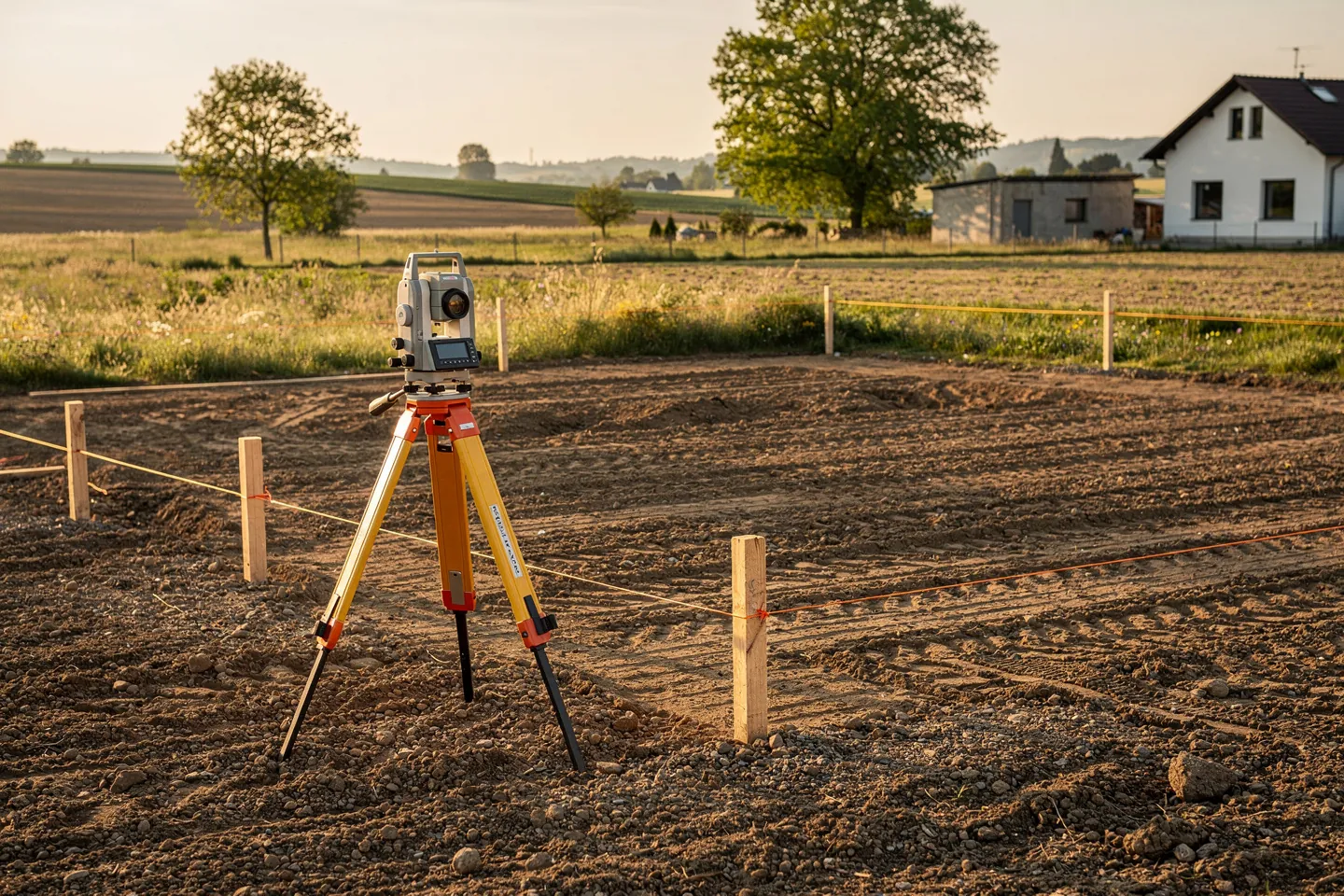
Fencing, setting up and equipping the site, access, water and power supply, clearing vegetation, stripping the humus layer of agricultural land, removing waste and marking the building are preparatory works, not the start of construction (§ 41). Marking the building is not setting out. Setting out is covered by § 42. The authority deadlines before this point are covered in How building a house works in Slovakia.
Who sets out the building, and when?
A new building, an extension and terrain works may only be built after a surveyor has set them out on the ground. The exception is a minor structure that needs only a notification (§ 42(1)). The set-out position must match the final decision on the building intent and the setting-out drawing (§ 42(2)). The surveyor must meet the requirements of the surveying act. To authorise the results of selected activities, the surveyor must be entered in the list or register of authorised surveyors and cartographers (§ 40(1)).
Decree No. 209/2025 Coll. divides the work into two steps (§ 4(1), (4), (5) and (9)):
- Setting out the spatial position marks the main axes, main points and main height points of the building.
- Detailed setting out follows the detailed setting-out drawings and may be done part by part.
The basis is the setting-out drawing of the spatial position. It shows the building, the boundaries of the plot and neighbouring plots, neighbouring buildings, utilities on the plot, the points of the setting-out network and the coordinates of the foundation points with accuracy criteria (decree, § 3(3)). Setting out runs the opposite way to a geodetic survey of the plot: points from the drawing go onto the ground.
The setting out is checked twice. The surveyor who set it out checks correctness, usually by repeating it independently, and records the differences (§ 4(6) and (8)). A different surveyor carries out the quality check against the project (§ 4(12) to (14)). The result is a setting-out record and an entry in the construction diary (act, § 42(3)).
How is the site handed over to the contractor?
The construction site is the area defined in the building intent for placing the building and the site facilities and for carrying out the works. It covers the building plot and, to a defined extent, other plots (§ 6(1)). The decision lists those plots using cadastral data (§ 60(1)(c)).
At the site handover the contractor receives the verified project, the final decision and the land (§ 30(3)(b)). The act sets no form for the record. The contract for work does. The date matters, because the construction diary records the works from the taking over of the site (§ 10(2)).
If different surveyors work during preparation and during construction, the first hands the second, before construction starts, the base data, the setting-out network, the corner points of the plot boundary and of the site facilities area (if not fenced), marks for utilities and underground structures, and the record of setting out the spatial position. Both sign a handover record (decree 209/2025, § 5(1) and (2)). The client then protects the setting-out network points on site (act, § 30(4)(f)).
What must be ready before work starts, and who provides it?
The act describes the site twice: as requirements for the site (§ 6(3)) and as the site manager's duties in running it (§ 38(1)). Government Regulation No. 396/2006 Coll. adds the sanitary minimum.
| What | Who provides it | Rule |
|---|---|---|
| Verified project and final decision with the contractor | Client | 25/2025, § 30(3)(b) |
| Notice of start of works to the building office | Client | 25/2025, § 30(3)(a) |
| Setting out of the building and its record | Surveyor, engaged by both client and contractor | 25/2025, § 42, § 30(4)(e), § 32(2)(a) |
| Fencing and a lockable entrance | Site manager | 25/2025, § 38(1)(a) |
| Site marking | Site manager, as the decision requires | 25/2025, § 38(1)(b), § 60(1)(d) |
| Access for deliveries, fire engines and ambulances | Site manager | 25/2025, § 38(1)(d) |
| Water and power supply | Contractor, if the works need them | 25/2025, § 32(2)(c), § 38(1)(f) |
| Storage space and waste removal | Site manager | 25/2025, § 38(1)(e), (g) |
| Toilets, washbasins, drinking water, first aid | Employer on site | 396/2006, § 8(1), Annex 3 |
| Health and safety plan | Client, before the site is set up | 396/2006, § 3(2) |
Site facilities are temporary structures for running the site, in particular storage, space for machinery and uncontaminated soil, workshops, accommodation and sanitary facilities (§ 6(2)). The regulation gives no number of toilets. It requires an "adequate number" of toilets and washbasins near the workplaces (Annex 3, point 14.3) and enough drinking water or other suitable non-alcoholic drinks (point 18.2). The site manager decides where site facilities such as storage and sanitary facilities go and how they connect to the utility networks (act, § 37(3)(f)).
What must the site board show?
The site must be marked as a construction site with basic details of the building and of the parties to the construction (§ 6(3)(b)). The decision on the building intent may set requirements for marking the site and the building (§ 60(1)(d)). The act gives no fixed template for the site board, so read what your own decision says about marking.
Regulation 396/2006 requires a second notice. Before work starts, the client posts a notice under Annex 1 visibly on site and updates it when anything changes (§ 3(4)). The client also submits the same notice to the labour inspectorate if the planned works will last more than 30 working days with more than 20 people working on site at the same time, or if the planned works exceed 500 person-days (§ 3(3)).
When is a safety coordinator required?
The client appoints a safety coordinator for every site where more than one employer, or more than one self-employed person without employees, will work (regulation 396/2006, § 3(1)). On a family house this happens when two firms with employees work there, for example a builder and an electrical firm, or when two self-employed people without employees work there. In the same case the client also appoints a documentation coordinator, who is a designer and prepares the health and safety plan (§ 5).
The safety coordinator may be a person authorised to act as site manager, a person authorised for construction supervision, or a safety technician. A site manager may not coordinate the site he or she manages (§ 6(1)). The coordinator sees that the plan is followed, that firms cooperate and that only people who work there enter the site (§ 6(2)). The contractor must respect the coordinator's instructions (act 25/2025, § 32(2)(f)). Appointing coordinators does not relieve the client of responsibility (regulation, § 3(5)).
Who is responsible for the site?
| Role | What it does on site | Rule |
|---|---|---|
| Client | Notifies the start, hands over the site, engages a surveyor for the whole works, protects network points, appoints coordinators | 25/2025, § 30(3), (4)(e), (f); 396/2006, § 3 |
| Contractor | Provides the site manager and the surveyor, names the chief surveyor, provides water, power and site equipment | 25/2025, § 32(2)(a), (c), (d) |
| Site manager | Runs the site, manages its operation, keeps the diary and decides on entry by outsiders | 25/2025, § 37(1), § 38 |
| Surveyor | Builds the setting-out network, sets out the building, draws up the record and checks the position throughout | 25/2025, § 40(3)(d), (e), (f), § 42(3) |
| Safety coordinator | Coordinates safety between firms according to the plan | 396/2006, § 6 |
The contractor provides the site manager, and the act entrusts the running of the site to him or her (§ 32(2)(c), § 37(1)). People other than those listed in § 38(2) may enter only with the site manager's consent and escorted (§ 38(3)). Anyone who fails to secure the site and its facilities, or the setting out and the match of the position to the project, commits an offence with a fine of 30 to 300 euros (§ 79(1)(b), (c), (6)(a)). A firm that lets an outsider onto the site faces a fine of 100 to 500 euros (§ 80(1)(e)). In self-build the care for site equipment and operation passes to the client (§ 30(6)(e)). See the article Self-building a house.
How do you keep the construction diary from day one?
The site manager keeps the construction diary. It is available for entries and checks from the first day the site is set up until the building is handed over (§ 39(1)). It is normally kept electronically (§ 10(2)) and, together with the verified project, must be on site for the whole construction (§ 6(5)).
The setting-out entry states what was set out, the surveyor's name, the date, the reference of the record, the number and type of marks, and the signatures of whoever handed over the points and whoever took them over (decree 209/2025, § 4(10)). The client, the surveyor and the safety coordinator may also make entries (act, § 39(2)(b), (c), (g)). The verification clause lapses if work does not start within two years of its issue and the authority set no longer period (§ 65(6)). So write the date of the start of construction in the diary on the same day.
What changes from 1 January 2027?
Amendment No. 243/2026 Coll. applies on these points from 1 January 2027 and is not law before then. The start of works will be notified to the building office on a designated form (Art. I point 89). The exemption for minor structures needing notification drops out of § 42(1), and the setting-out duty for terrain works narrows to those that need a decision on the building intent (point 104).