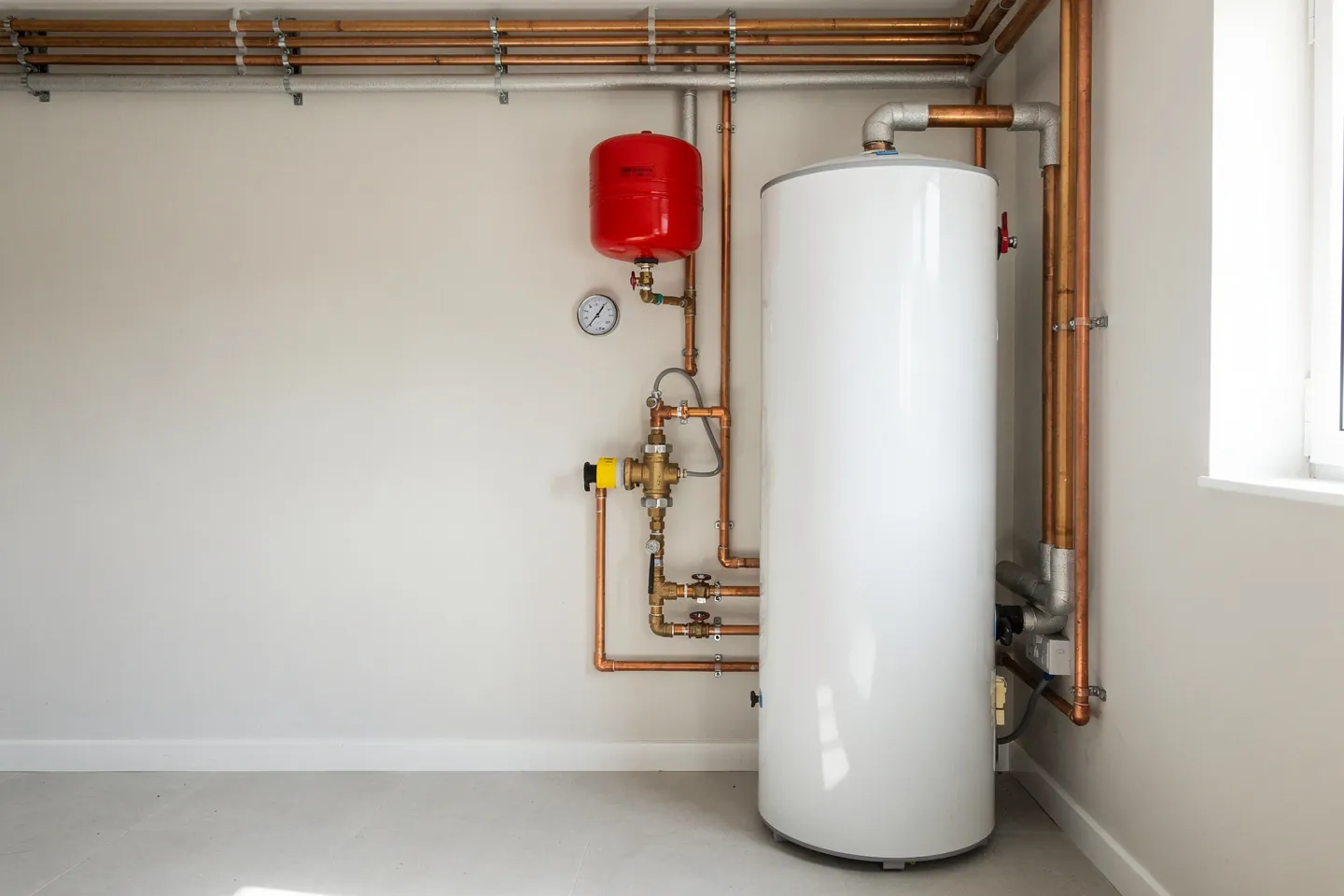
Why is hot water such a large item in an energy-efficient house?
Insulation, good windows and heat recovery ventilation reduce the heat needed for space heating, but they do not make a shower smaller. Domestic hot water preparation therefore deserves attention at the design stage. According to Eurostat, water heating took 15.6 % of final energy consumption in EU households in 2024 and space heating 61.5 %.
To estimate the demand, designers use the balance from ČSN 06 0320. The teaching materials of the Faculty of Civil Engineering at STU also quote it. For housing it assumes 82 litres of hot water at 55 °C per person per day, which is 4.3 kWh of heat. By this design value, a family of four needs about 17.2 kWh a day, around 6,280 kWh a year. Under the criteria described in Passive House Guide, a passive house may have a space heating demand of at most 15 kWh/(m²·year). On 150 m² of treated floor area (TFA) that is at most 2,250 kWh a year, less than the design demand for hot water. The same materials say that actual consumption is lower than 82 litres in many locations, so this is a design value with a margin.
What are the options for heating water and how do they differ?
Water heats either directly, for example by an electric element immersed in the water, or indirectly through a heat exchange surface between two liquids. A second distinction separates storage heating, which heats water into a store, from instantaneous heating, which heats it only while it flows. The table compares six options that suit a family house.
| Option | How it heats | Advantage | What to watch |
|---|---|---|---|
| Electric storage water heater | An electric element directly in the stored water | A store of water covers the peak, so a lower power input is enough | According to the DOE, for the same heat it can use 2 to 3 times more electricity than a heat pump water heater |
| Indirect hot water cylinder | A coil in the cylinder is fed by a heat pump or a boiler | One heat source for space heating and water | The water in the cylinder must be kept at a temperature that limits legionella, see below |
| Heat pump water heater | A compressor moves heat from the air into the water in the cylinder | The most economical electric heating in this comparison | It takes heat from the room it stands in or from ducted air |
| Instantaneous water heater | It heats water only while it flows | No storage cylinder is needed | It needs a large power input, and the temperature can fluctuate at the peak |
| Solar collectors with a twin-coil cylinder | One coil is fed by the solar circuit, the other by a boiler or heat pump | Heat from the sun directly, with no conversion to electricity | It needs a second source for top-up heating |
| PV with a surplus diverter | Surplus electricity from the panels goes to an electric element | It uses electricity that would otherwise go to the grid | It works only when there is a surplus, and in winter there is little |
Electric water heater or heat pump for hot water?
The price of a kilowatt-hour of heat decides, not the price of the appliance. An electric water heater converts electricity into heat directly in the water. A heat pump moves heat from the surrounding air into the water. According to the US Department of Energy (DOE), it can be 2 to 3 times more efficient than a conventional electric resistance heater.
The STU materials give the example of a compact heat pump water heater with a 220-litre cylinder. Tested to EN 16147, it reaches a COP of 3.28 with air at 20 °C and 3.07 at 7 °C. Its rated water temperature is 55 °C. The compressor heats water up to 65 °C. It works with intake air from -8 to +42 °C. According to the ENERGY STAR programme, such units switch automatically to the electric resistance element during high demand, which is their least efficient mode.
If an air-to-water heat pump already heats the house, it can also heat a hot water cylinder. The STU materials show this connection, also together with solar collectors. The article Underfloor heating or radiators with a heat pump explains the heating water temperature and its link to the heat pump.
How big a hot water cylinder for four people?
The cylinder must cover the peak, for example four showers in a row in the evening, not the daily consumption. The STU materials quote ČSN 06 0320. It gives a dose of 40 litres of water at 55 °C for one shower and 80 litres for a bath. Mixing with cold water gives 1.5 times that volume, so 60 litres of water at 40 °C per shower.
According to the same materials, the cylinder volume follows from V = Vz · (θz - θs) / (θ0 - θs). Vz is the volume of mixed water at temperature θz, θs is the cold water temperature and θ0 the water temperature in the cylinder. Take four showers (240 litres at 40 °C), cold water at 10 °C and a cylinder heated to 60 °C. The result is 240 · 30 / 50 = 144 litres. If you also run a bath in the evening, add another 72 litres. The designer adds losses to the result and checks how fast the source reheats the cylinder.
The STU materials do not recommend the old STN 06 0320 standard from 1986 for storage heating, because it leads to oversized volumes. They refer to the revised ČSN 06 0320 from 2006, to DIN 4780 for apartment buildings and to the methods of water heater manufacturers.
Regulation (EU) No 814/2013 helps when comparing products. Every water heater meets at least one load profile, a test cycle of draw-offs with a sum of useful energy Qref. A storage water heater with a declared profile of M or higher must deliver at least a set quantity of mixed water at 40 °C.
| Load profile | Reference energy Qref | Minimum mixed water at 40 °C | Minimum water heating efficiency |
|---|---|---|---|
| M | 5.845 kWh | 65 l | 36 % (from 26 Sept 2017) |
| L | 11.655 kWh | 130 l | 37 % (from 26 Sept 2017) |
| XL | 19.07 kWh | 210 l | 37 % (from 26 Sept 2017) |
| XXL | 24.53 kWh | 300 l | 60 % (from 26 Sept 2018) |
Four showers by ČSN need 240 litres of mixed water, which is more than the minimum for profile XL. What counts, however, is the quantity of water at 40 °C that the manufacturer declares in the data sheet, not the profile letter alone.
What hot water temperature should you set because of legionella?
According to the World Health Organization (WHO), Legionella bacteria live and grow in water systems at 20 to 50 °C, best at 35 °C. Most often, people breathe in contaminated aerosol, for example in a shower. The WHO therefore advises keeping hot water above 50 °C, with water leaving the heater at 60 °C or more. Cold water should stay below 25 °C, ideally below 20 °C. The entry on legionella prevention describes further measures.
Slovak Act No. 355/2007 Coll. on public health sets the hot water temperature at the final consumer's outlet. It must be at least 50 °C and at most 55 °C (§ 17e(2)). The duties of a hot water supplier apply to an entrepreneur or legal person. This is a person who supplies hot water, or uses it in business or in the public interest (§ 17e(6) and (7)). Decree No. 91/2023 Coll. lists priority premises for legionella risk, for example hospitals, residential social care facilities, accommodation facilities and artificial swimming pools (§ 7(3)). A family house is not on this list.
A thermostatic mixing valve closes the gap between 60 °C in the cylinder and at most 55 °C at the outlet. It adds cold water to the hot water so that the outlet has the set temperature, and it protects against scalding. The manufacturer ESBE gives two statements for its VTA320 and VTA520 valves. The hot water at the inlet must be at least 10 °C warmer than the mixed water at the outlet. The valves also suit systems with circulation. For a 50 °C outlet, the cylinder therefore needs at least 60 °C.
Is hot water circulation worth it in a family house?
Hot water circulation is a return pipe with a pump that keeps the required temperature even at the most distant outlet, including at night. According to the STU materials, you do not connect any fixture to the circulation pipe. The comfort of hot water flowing at once is paid for with constant heat loss from the pipe.
In an analysis on the TZB-info portal, Prof. Jaroslav Valášek recommends a distribution without a circulation pump for smaller buildings, for example family houses. Daily heat loss limits the length of a system without circulation. It should not exceed the loss of a system with circulation, including the pump's consumption. In his analysis, a pipe length of up to 10 metres gives an efficient energy regime. A length of up to 14 metres is acceptable if the kitchen sink is no more than 3 metres from the cylinder. For a well-insulated circulation pipe he allows a heat loss of at most 10 W/m. At that limit, 20 metres of pipe would lose up to 4.8 kWh a day. That is more than a quarter of the design demand of the family of four from the start of this article.
For the floor plan this gives a simple rule: place the bathrooms, kitchen and plant room close together. A short distribution then often needs no circulation.
How do you heat water with surplus PV power?
A PV surplus diverter sends electricity to an electric element in the cylinder. This is electricity that the house is not using and that would otherwise go to the grid. The manufacturer myenergi states that its eddi diverter decides more often than once a second how to use the generation. It can heat water with power below 1 kW. The cylinder thus stores the surplus as heat. A heat pump water heater makes more heat from the same electricity. The STU materials list a PV connection option for the compact unit as well.
The limit is seasonal. In winter a PV array produces little, as Solar PV on a Family House shows, so the cylinder also needs another heat source.
Can you recover heat from shower water?
Drain water heat recovery passes warm waste water from the shower through a heat exchanger. The exchanger preheats the cold water that flows to the shower or to the water heater. A 2025 study by Oak Ridge National Laboratory compared two layouts. Under similar conditions, vertical exchangers on a drain pipe reach a higher heat transfer effectiveness than horizontal ones. At low flow, however, their surface may not be fully wetted and effectiveness drops.
If there is no room for a vertical exchanger, a horizontal one under the shower is an option. Kordana-Obuch and Starzec (2022) tested a compact horizontal exchanger designed to sit below a shower tray. Its efficiency was 22.43 to 31.82 %, depending on the cold water temperature and the flow rate. The linear version reached at most 23.03 %. According to the authors, the investment pays off mainly where an electric water heater heats the water.