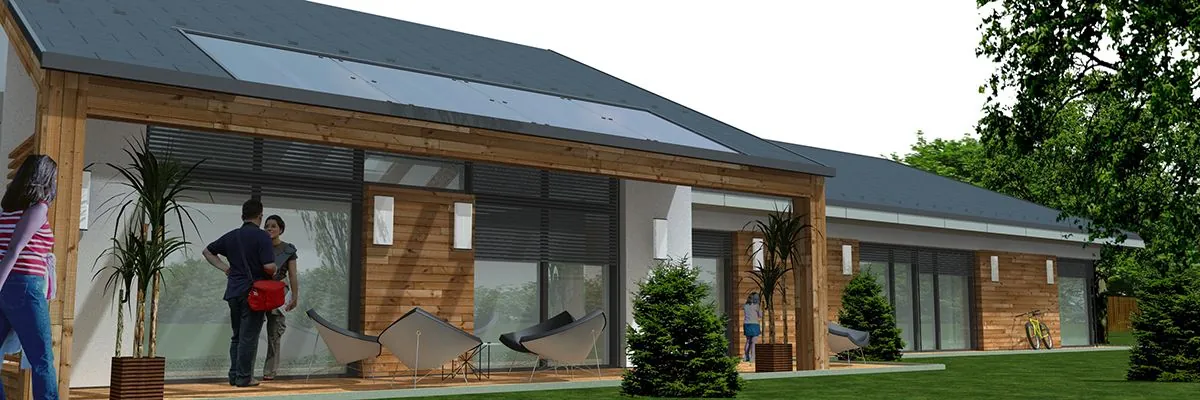
An array is sized by consumption, not by spare roof
The most common mistake with solar on a family house is simple: the client looks at the south roof plane, counts how many panels fit on it, and that number becomes the brief. The roof is only an upper limit. The real brief is the household's consumption through the day, because the economics are not decided by how much the array produces, but by how much of it the house uses at the moment it is produced.
The reason is price. A kilowatt hour drawn from the grid costs the full rate including distribution and levies. A kilowatt hour that a photovoltaic panel makes and the house uses straight away saves that whole cost. Surplus exported to the grid is worth only a fraction, and depending on the settlement model it ranges from a low buy-back price to a simple volume offset. The gap is large enough that two installations with the same rated output and the same annual yield can have completely different payback, purely according to when the household is at home.
Self-consumption decides the economics
Self-consumption is the share of generated electricity the house uses directly. On a family house with no load management at all, that share is typically somewhere between a quarter and two fifths of annual output, because the array peaks at midday when the house is most often empty. The rest flows to the grid and comes back at a value that does not match the saved kilowatt hour.
An oversized array on a house with unmanaged loads is therefore a worse investment than a smaller array fully covered by the household's own demand. Every additional kilowatt of peak output above what the house can absorb pays back more slowly than the one before it. The first few kilowatts on an ordinary house pay for themselves almost certainly; the eighth does so only if there is demand for it.
The order of reasoning is thus the reverse of the usual one: first what the house consumes during the day and what it could consume, then the array size, and only at the end a check that the chosen size fits on the roof.
What actually raises self-consumption
Self-consumption can be raised in two ways: move demand into daylight hours, or add an appliance that turns the daytime surplus into something useful. Four things work in practice, and they work very differently.
- A heat pump is the strongest tool, but seasonally offset: it heats hardest in December and January, when the array delivers least. In the shoulder seasons and for hot water it absorbs the daytime surplus reliably.
- A hot water tank is the cheapest store a house can have. Heating controlled to run at midday rather than at dawn moves several kilowatt hours a day into the hours when they are effectively free, and needs nothing more than a timer or simple control.
- Timed appliances, meaning the washing machine, dryer and dishwasher on delayed start for lunchtime, are a small thing that repeats daily and costs nothing.
- An electric car changes the picture most of all, but only if it sits at home during the day. A car charged after ten in the evening raises self-consumption not at all.
The table matches a household profile to an array size that suits it. The bands are indicative and should be checked against the house's real annual consumption.
| Household profile | Sensible size band | Storage | Character of self-consumption |
|---|---|---|---|
| Two people working, house empty by day, gas heating | roughly 3 to 4 kWp | usually not | low, output peaks away from demand |
| Someone at home during the day, no heat pump | roughly 4 to 6 kWp | consider later | moderate, driven by cooking and daily running |
| Heat pump and controlled hot water heating | roughly 5 to 8 kWp | tank before battery | good in spring and autumn, weak in winter |
| Heat pump and an electric car charged at home by day | roughly 7 to 10 kWp | a battery starts to pay | high, demand covers the midday peak too |
| Pool, air conditioning or a heated workshop | from metering, not from the roof | according to the load curve | summer-weighted, tracks generation |
Where a battery starts and stops making sense
Home storage generates nothing; it only shifts consumption from midday to evening. It therefore makes sense once self-consumption has been exhausted by cheaper means and the house still has a substantial surplus. Where the hot water still heats at six in the morning and the washing machine runs at seven in the evening, a battery is an expensive patch on a problem a timer solves.
Sensible capacity follows evening demand, not array size: the store should cover one ordinary evening and night, not several days. A battery also does nothing for winter, when there is barely any surplus, so on a house with a heat pump it should not be understood as a way to leave the grid in January. Backup supply during an outage is a separate subject, needs different wiring, and not every system can do it.
Orientation and pitch: why east-west often beats pure south
South at a pitch of around thirty degrees gives the highest annual yield at our latitude. That does not mean it gives the most money. A south array produces a narrow, tall midday peak that an ordinary household cannot absorb, so much of that peak flows to the grid. An array split across an east and a west plane produces somewhat less over the year, but spreads generation into a wider band with a morning and an afternoon maximum, which is exactly when the household actually draws power.
Pitch behaves similarly: steeper shifts yield towards winter and a low sun, shallower towards summer. On a flat roof panels are usually not laid flat but set on modest frames, which also improves self-cleaning by rain. The orientation of the house itself, meanwhile, is a decision taken long before the solar, when siting the house on the plot.
| Orientation and pitch | Annual yield against the optimum | Shape of the daily curve | Who it suits |
|---|---|---|---|
| South, pitch 30 to 35 degrees | reference optimum | narrow, tall midday peak | a house with large midday demand |
| South, flat roof on frames up to 15 degrees | roughly a tenth lower | flatter peak, strong summer | a house with air conditioning or a pool |
| East and west, pitch 30 to 40 degrees | roughly a fifth lower | two gentle maxima, morning and afternoon | a family with morning and evening demand |
| South-east or south-west, 30 to 40 degrees | close to the optimum | peak shifted by an hour or two | most ordinary houses |
| North and north-east | much lower, usually uneconomic | flat, with no usable peak | only as a top-up where area is short |
Shading: the chimney, the dormer and the neighbour's tree
Shading is the one factor that can devalue an otherwise well designed array out of all proportion to the area involved. Panels wired in one string share a common current, so a single module shaded by a chimney drags down the output of the whole string, not merely its own share. That is why a shadow the size of a palm can cost several per cent of annual output.
This is precisely what optimisers and microinverters exist for: they let each module work at its own operating point. They are not, however, a substitute for a shading study. A chimney, a dormer, an aerial mast and the neighbour's tree can all be drawn in advance, and some of them can be moved or merged while the roof is still being designed. A tree also grows, so it is judged at its mature height, not today's.
The array is a permanent part of the roof, not an add-on
This is the part that writing about solar usually leaves out. An array is a permanent element of the elevation, an area of some tens of m2 on the most visible plane of the house. If it arrives afterwards and is assembled wherever space happens to be left, the house shows it at once: stepped edges, panels split around a roof window, a frame in a different colour from the tiles.
The difference between a good and a bad result is mostly a question of order, not budget. An array designed together with the roof can be aligned with the edge, kept as one rectangle, colour-matched to the covering, or set flush in the plane of the covering as an integrated solution. At the same time everything underneath can be coordinated: the rafter and batten layout for the fixings, the position of the cable penetrations, the cable route to the plant room and space for the inverter.
An array also loads the roof, both with its own weight and by changing how wind and snow act on the surface beneath it. On a new build the structural engineer allows for this in the roof design; on an older house the condition of the structure has to be assessed. And one sequence is broken more often than any other: if the roof is due to be re-covered, the panels belong on the new roof. Mounting onto the old covering means paying to strip and refit the whole installation.
Connection and the support routes
Solar is not only a building matter but also a relationship with the distribution system operator. The process has a settled shape: an application to connect the source, the operator's position with conditions and an output limit, a contract, the installation with an electrical inspection report, and finally the swap of the meter for a bidirectional one. A smart metering system records import and export separately, because that split is what determines what gets settled as saved and what as exported.
On support, the same rule applies as in the guide to the house renovation subsidy: you can rely on the mechanism, not on a figure from last year's article. Solar on a family house is supported either as a voucher under the Zelena domacnostiam programme administered by SIEA, or as one measure within a comprehensive renovation. Double funding of the same item from two programmes is generally not possible. Amounts, caps and deadlines change between rounds, so check them in the current call before signing any contract with an installer.
Conclusion
Solar adds up well when it is designed in the right order. First look at what the house consumes during the day and what it could consume, then set the array size and the cheap ways of raising self-consumption. A battery comes only after that. Orientation and shading decide the shape of the daily curve, not just the annual total. And the array has to be designed together with the roof rather than stuck onto it afterwards. A free roof is only the space available, not the answer to how many panels the house needs.