Obnov Dom is Slovakia's best-known state subsidy for renovating family houses, and also one of the topics where outdated or invented figures circulate most often online. The programme runs as repeated call waves with shifting conditions, caps and eligible applicants, so any specific euro figure in an older article may already be out of date a month after publication. This guide therefore splits its content in two: the mechanism of the programme, which changes slowly, and the current state of the call waves, which changes fast and is summarised in one clearly marked section below, dated to when it was verified.
What Obnov Dom is and who it's for
The Obnov Dom programme funds energy renovation of family houses from Slovakia's Recovery and Resilience Plan, the package Slovakia draws from the EU's post-pandemic recovery fund. The applicant is always the owner or co-owner of the house, never a company or developer, and the house has to meet the age and typology criteria of the specific call. The programme is run by the Slovak Environment Agency (SAŽP), which also evaluates applications and disburses the funds.
The programme's intent is straightforward: reduce the energy demand of the older housing stock that makes up a large share of Slovak family houses, while helping households for whom renovation would otherwise be financially out of reach. That's exactly why, over the years, the programme has split support into several tracks that differ in target group and in the scope of measures they support.
Shallow versus deep renovation: why the deeper tier pays more
In practice it's useful to distinguish two levels of support. The first is a simpler, faster track aimed mainly at households threatened by energy poverty (for example pensioner households, or low-income families with several minor children), covering a narrower set of measures with a lower support cap but noticeably lighter paperwork. The second is the standard, full-scope deep renovation track, aimed at reducing a house's energy demand comprehensively across several areas at once: the building envelope, the heat source, ventilation, and possibly renewables.
Deep renovation isn't worth more just because it's "bigger." It pays proportionally more because, in most calls, the amount and the reimbursement percentage are tied to the achieved reduction in primary energy demand: the greater the real, demonstrated energy benefit, the higher the cap and the share of eligible costs the applicant can claim. It's a reward for measurable outcomes and comprehensiveness, not an automatic bonus for scope. This is exactly why it pays to work through the recommended order of measures for a deep renovation already at the financing-planning stage, not only at the design stage: the sequence directly affects how much energy the renovation actually saves, and therefore which support tier the application ends up in.
| Aspect | Shallow renovation (mini variants) | Deep renovation (standard call) |
|---|---|---|
| Who it's for | Households threatened by energy poverty, pensioner households, families in material need | House owners generally, no income restriction |
| Scope of measures | Narrower selection: insulating part of the envelope, replacing openings, a simpler heat-source swap | A comprehensive package at once: envelope, heat source, ventilation, possibly renewables |
| Energy audit or certificate | Usually not required, paperwork is simplified | Usually a mandatory attachment (a project energy assessment or pre-renovation certificate) |
| Amount and percentage of support | Lower cap, a flat percentage regardless of the achieved savings | Higher cap, percentage and amount graded by the demonstrated primary-energy savings |
| Speed of disbursement | Advance payment available soon after approval, faster process | Advance payment also available, but the audit paperwork extends the process |
What the energy audit and project documentation are actually for
An energy audit isn't a box the applicant ticks for the programme's sake. It's the document that establishes what the house actually needs, in what order, and what energy savings can realistically be expected. On the deep renovation track, the audit is usually accompanied by an energy performance certificate both before and after the renovation, which proves how much the house actually improved and serves as the basis for settling the subsidy.
Project documentation matters just as much, since it's what lets the scope of works, construction build-ups and material specifications be pinned down unambiguously, a document similar in role to a bill of quantities on an ordinary build. Without that level of detail, an application is hard to assess, and quotes from different contractors are just as hard to compare later. For renovations planned in stages spread over a longer period, it's increasingly worth working with the concept of a building renovation passport, a long-term sequencing plan for a specific house that can be revisited at each new stage instead of reinventing the order of works from scratch.
The application sequence and what most often causes rejection
In most calls, an application moves through a similar sequence: registering and verifying the applicant's and house's eligibility, preparing the project documentation and the energy assessment, submitting the application within the deadline or before the round's capacity fills, formal and expert evaluation, signing the contract, disbursing the advance payment, carrying out the works, and finally the closing settlement with supporting documents.
The most common causes of rejection or a reduced subsidy are rarely exotic:
- A mismatch between the project documentation and the energy audit - the measures in the application don't match what the audit recommended or what the design actually specifies.
- Incomplete or incorrect ownership documents - unresolved co-ownership, a mismatch with the land registry, or a missing consent from one of the co-owners.
- Not following the required contractor-selection procedure - some calls require a specific procurement method or a minimum number of contractors approached, a step applicants sometimes skip.
- Work carried out before the contract is signed, or outside the approved scope - costs incurred early, or for measures that weren't part of the approved application, generally can't be reimbursed.
- The round's capacity fills up - for popular calls the application limit can fill within hours to days, so a formally correct application submitted late may simply not be accepted into that round.
How reimbursement actually works: who pays first
This is the point many applicants underestimate. Obnov Dom isn't a subsidy paid in full before work begins. The usual mechanism works like this: once the application is approved and the contract signed, the applicant can receive an advance payment covering part of the planned project scope, enough to get the works started. The applicant typically funds the rest themselves, whether from savings or a loan, and only after the works are finished and invoices, handover protocols and other documents are submitted does the settlement of the remaining subsidy arrive.
For a household's budget this means one thing: financing has to be arranged for the whole scope of works before applying, not just for the portion the advance covers. The waiting period between submitting invoices and the remaining subsidy landing can stretch to weeks or months, and that gap in cash flow tends to be a bigger problem for smaller households than the size of the subsidy itself.
Obnov Dom and Zelená Domácnostiam: two separate programmes, different administrators
A common misunderstanding is that Obnov Dom covers absolutely everything, including the heat source and photovoltaics. In reality, separate schemes run alongside it, the best known being Zelená Domácnostiam, administered by the Slovak Innovation and Energy Agency (SIEA), a different body from Obnov Dom. Zelená Domácnostiam works through vouchers for a specific piece of equipment: replacing a heat source with a heat pump or biomass boiler, or installing photovoltaics or solar thermal collectors.
In practice this means an applicant usually has a choice: fold the equipment into an Obnov Dom application as part of a comprehensive renovation, or apply for a separate voucher through Zelená Domácnostiam, since combining both funding routes for the same item generally isn't possible. Which path is more advantageous depends on whether the house is going the deep-renovation-with-audit route, where it's worth including the heat source in one overall project, or is only addressing a standalone heat-source swap without further envelope work.
Current state of the call waves as of 27 July 2026
The table below summarises the state I verified as of this article's publication date. This is the only part of the text carrying specific amounts and dates, deliberately so: conditions change between waves, so this section will be the first, and only, part updated for the next wave, while the rest of the article remains valid regardless of which wave happens to be running.
| Call / programme | Status as of 27 July 2026 | Key parameters |
|---|---|---|
| Obnov Dom mini+ | Open since 15 July 2026; the first round's 5,000-application capacity filled within the first day, applications are under evaluation | Support up to €11,000 per house, advance payment up to 50% of the project scope (max €5,500), roughly €186 million allocated overall, no energy certificate required, aimed at households threatened by energy poverty (income threshold tied to 2024 figures) |
| Obnov Dom, standard call (Wave 6) | First round ran 13 Dec 2024 to 15 Jan 2025; further rounds of this wave reportedly followed, but whether a round is currently open should be checked directly on obnovdom.sk | Support roughly in the €15,000-19,000 range depending on achieved primary-energy savings, reimbursement up to 75% of eligible costs (higher for socially disadvantaged applicants), an energy assessment or certificate mandatory |
| Zelená Domácnostiam 2026 | Budget over €28 million; a new batch of vouchers was expected to activate in Q3 2026 | Reimbursement up to 50% of eligible costs, indicative caps vary by equipment (roughly low thousands of euros for a heat pump, somewhat less for photovoltaics) |
Exact amounts, percentages and deadlines change between waves, and a new round of the call may bring different figures than this table shows. Before any financial decision, always verify the current conditions directly on the programme's official site or with SAŽP, or with SIEA for Zelená Domácnostiam.
Insulating the envelope: what to consider when choosing a system
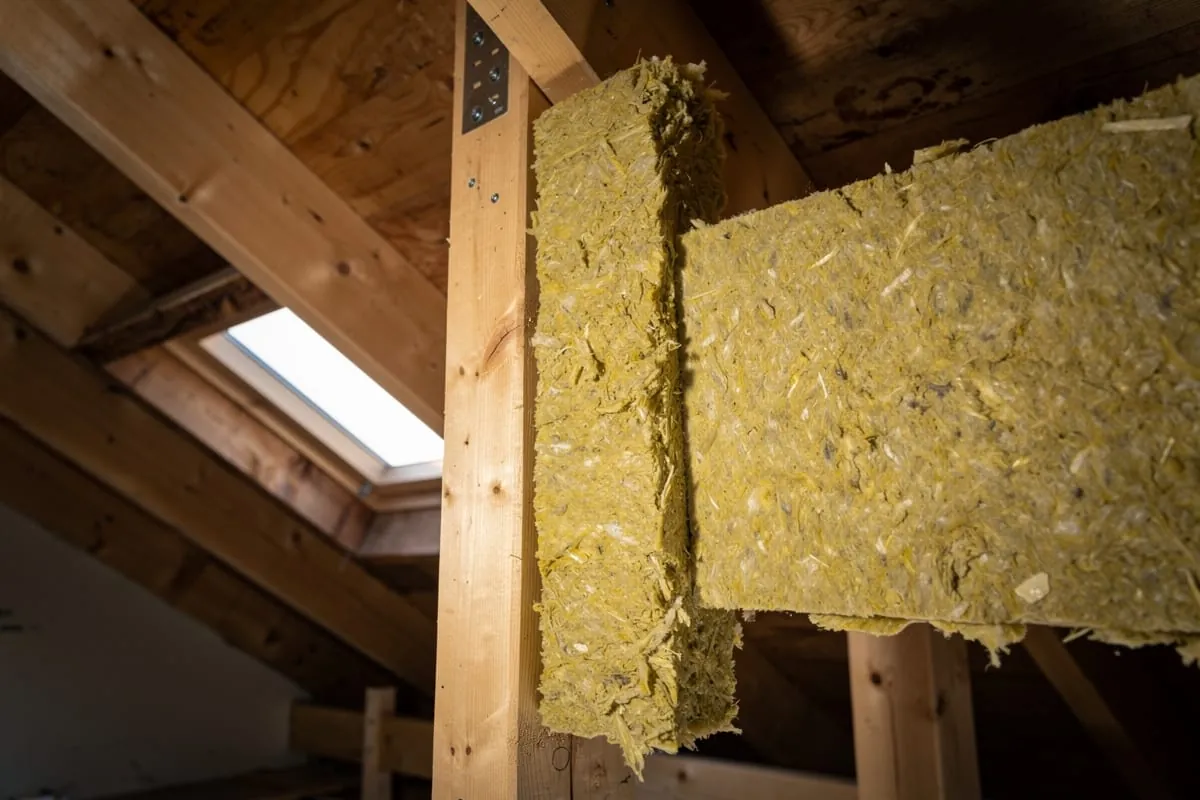
Whether a house takes the shallow or the deep renovation route, insulating the exterior walls is usually the largest line item in both the budget and the application. The most common solution in Slovakia remains the ETICS external thermal insulation system, a layer of insulant bonded and mechanically fixed directly to the facade and finished with render. The choice of insulation thickness and type should follow the energy audit and the designer's specification, not whatever happens to be cheapest from a given contractor. Shaving the insulation thickness below the recommendation saves a little on material but generally loses disproportionately more in achieved energy savings, and therefore in which support tier the application ends up qualifying for.
Practical recommendations before applying
- Don't start with the application, start with the energy audit. It establishes what the house actually needs and which support tier you'll realistically fall into.
- Arrange financing for the entire scope of works, not just the advance payment amount. The remaining subsidy only arrives after settlement, and that may not be quick.
- Verify the exact wording of the current call before signing any contract with a contractor. Conditions shift even in details that don't look important at first glance, such as the required contractor-selection procedure.
- If you're considering a heat source or photovoltaics, decide in advance whether to fold them into Obnov Dom or handle them separately through Zelená Domácnostiam, and don't leave that decision until the last minute.
- For a larger renovation, consult an architect or energy specialist about the order of measures already at the financing-planning stage, not after contracts with contractors are signed.
Conclusion
Obnov Dom is a genuinely useful tool for financing a family house's energy renovation, but it only works reliably when the applicant understands the mechanism, not just the figures from the last wave. Deep renovation pays more because it rewards a demonstrated energy outcome, not merely the scope of work. An energy audit and solid project documentation aren't administrative hurdles, they're what determines whether an application even qualifies for a higher support tier. And financing needs to be planned to cover the gap between incurring costs and receiving the settled subsidy, not just the headline support amount. Always verify the specific figures against the current call, the mechanism described above holds regardless of which wave happens to be running.