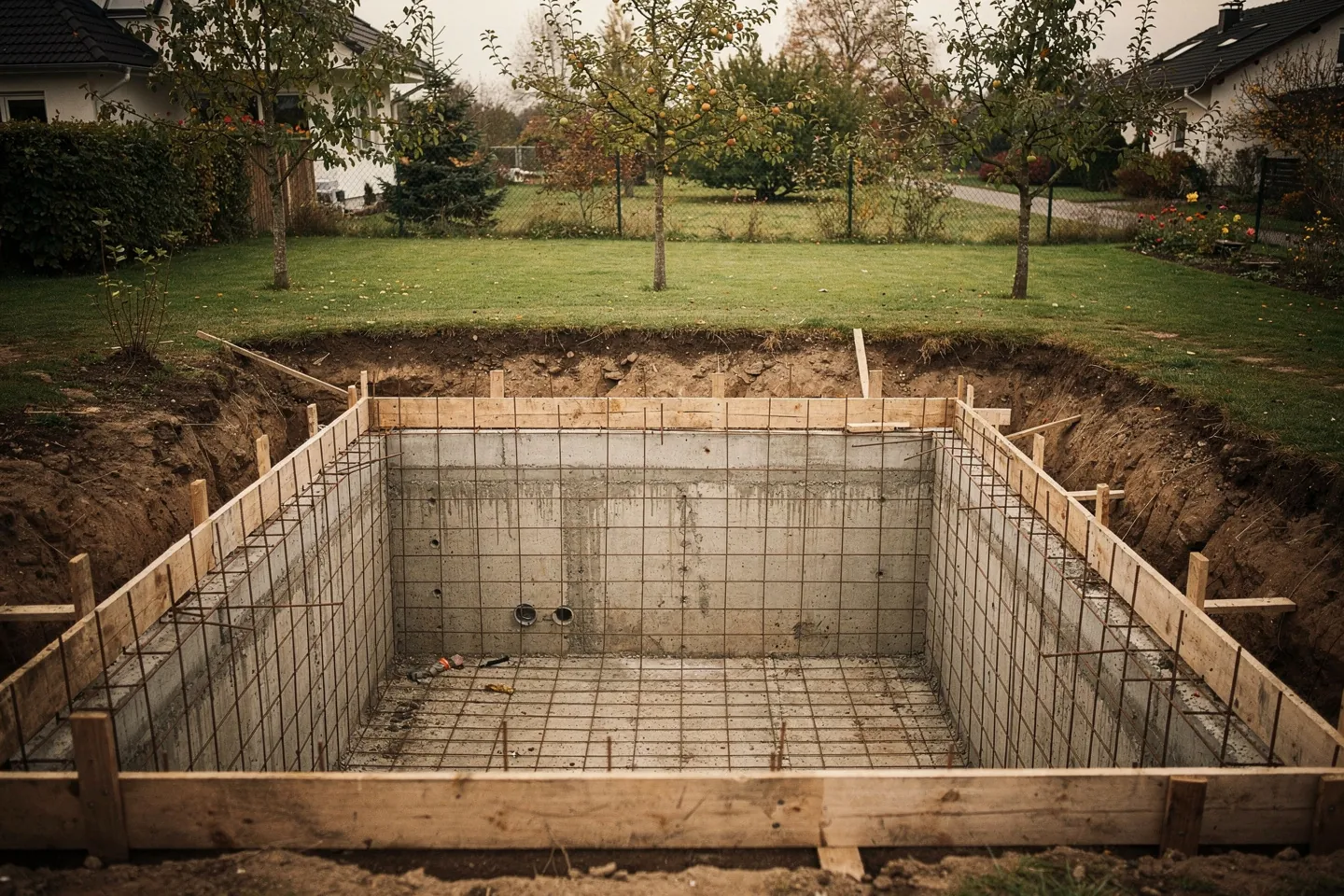
Does a garden pool need a notification or a permit?
The Building Act 25/2025 Z. z. applies from 1 April 2025 and names pools in one place. They belong to the underground minor structures whose built-up area does not exceed 25 m² and whose depth does not exceed 3 m (§ 2 ods. 4 písm. b). Until 31 December 2026 such a pool always needs a notification to the building office (§ 18 ods. 3). A larger pool is no longer a minor structure. The general rule then applies: every structure needs a decision on the building intent unless the act says otherwise (§ 18 ods. 2).
From 1 January 2027 the amending act 243/2026 Z. z. applies. Minor structures move to § 2 ods. 7, and the limit of 25 m² and 3 m for underground structures, pools included, stays. Notification is no longer automatic. It is needed when one of the conditions in § 18 ods. 3 applies, and one of them is building an underground structure (písm. e). The new § 18 ods. 4 písm. h) also requires a notification for an underground structure made by setting in an assembled product, if its built-up area does not exceed 50 m² and its depth 3 m. The term garden swimming pool describes pool types, the post Fence, garage, carport: what to notify covers other structures by the house, and the post How building a house works in Slovakia covers the whole process.
| Pool | Until 31 Dec 2026 | From 1 Jan 2027 |
|---|---|---|
| In-ground, up to 25 m² and 3 m deep | Notification, always (§ 18 ods. 3) | Notification, because it is an underground structure (§ 18 ods. 3 písm. e) |
| In-ground, above 25 m² or 3 m deep | Decision on the building intent (§ 18 ods. 2) | Decision on the building intent (§ 18 ods. 2), unless the row below applies |
| Underground structure made by setting in an assembled product, up to 50 m² and 3 m deep | No special rule, the rows above apply | Notification (§ 18 ods. 4 písm. h) |
| Above-ground | The definition of a structure decides (§ 2 ods. 1), the act sets no pool limit | The same, the definition of a structure decides |
The act does not say whether a prefabricated pool shell is an assembled product under letter h). If you plan a shell above 25 m², check this with the office before you order it.
What decides it: size, depth, a roof or utility connections?
The built-up area and the depth decide, not the volume of water. The first question, though, is whether the pool is a structure at all. A structure is a building construction firmly joined to the ground, or one whose placement needs a prepared base. The act counts a connection to utility networks and placement underground as a firm connection (§ 2 ods. 1 písm. d and e). An in-ground pool is therefore a structure. For an above-ground pool, the foundation, the base preparation and the anchoring decide.
A free-standing structure includes the technical and operating equipment without which it would not be complete and fit for operation (§ 2 ods. 2). The act does not say how this applies to a pool plant room. Ask the office whether its area counts toward the 25 m² limit.
The act does not name pool roofs. A ground-level construction fixed to the ground up to 50 m² and 5 m belongs to the group in § 2 ods. 4 písm. a). If you plan a sliding enclosure, have the office assess the pool and the enclosure together. The office can also send a notified pool to the building intent proceedings if the rights of third persons could be affected or conditions must be set (§ 63 ods. 5).
Skimmer pool or overflow pool?
The standard STN EN 16713-2 on circulation in domestic swimming pools names three points where water is taken from the pool: the overflow channel, the skimmer and the main drain (clauses 4.3.2 to 4.3.4). It deals separately with the risk of suction entrapment at suction outlets, skimmers included (clause 4.4). The related STN EN 16713-3 on water treatment lists cleaning of the overflow channel and of the balance tank as separate items (clauses 4.9.3 and 4.9.4).
A skimmer takes water from the surface through an opening in the pool wall. An overflow pool carries surface water into a channel, and a balance tank belongs to it. Three things are worth weighing: room for the tank, the precision of the level edge, and whether you want the water level flush with the terrace. An overflow pool adds a tank that needs a place and regular cleaning.
Sand or cartridge filter?
The standard STN EN 16713-1 lists four groups of pool filters: pre-coat filters with diatomaceous earth, disposable cartridges or filter bags, filters with a granular bed, and others such as membrane filters. It does not apply to natural and nature-like pools. The US EPA WaterSense guide compares the common filters as follows:
| Filter | Removes particles from | Media life | Maintenance |
|---|---|---|---|
| Sand | 20–40 micrometres | 3–6 years | Backwash once a week |
| Glass media | 5 micrometres | 7–15 years | Shorter backwash than sand |
| Diatomaceous earth | 5 micrometres | 2–3 years (grid) | Backwash every 4 to 8 weeks, then add new earth |
| Cartridge | 10 micrometres (can vary) | 2–4 years | Spray with a hose, no backwash |
The EPA says sand filters are the most common in residential pools because of their lower cost and easy maintenance. Cartridge filters save the most water because they need no backwash. The EPA quotes an estimate by the California Urban Water Conservation Council that filter backwashes account for 23 % of quantifiable pool water use. When you plan a filtration system, decide early where the backwash water will go. On pumps, the EPA says a variable-speed pump saves substantial energy compared with older models.
Saltwater electrolysis: is it a pool without chlorine?
No. Commission Implementing Regulation (EU) 2021/345 approves active chlorine generated from sodium chloride by electrolysis as an active substance, among others for biocidal products of product-type 2. The regulation speaks of active chlorine generated in situ and sets purity requirements for the salt as the precursor. With saltwater chlorination, the pool is disinfected by chlorine that the electrolytic cell makes from the salt dissolved in the water. The difference is how the chlorine gets into the water, not whether it is there.
The EPA also lists other treatment methods: ozone, ultraviolet light and copper-silver ionizers. In its words, all three reduce the need for chlorine, but ionizers work together with a low level of sanitizer. Anyone who wants water with no chemical disinfection at all looks at a pond.
Is a natural swimming pond a better choice?
The Bavarian State Institute for Viticulture and Horticulture (LWG) describes swimming ponds, following the rules of the German FLL society, as artificially created ecosystems. They are divided into a swimming area, a treatment area and a technical area. Depending on the design, the treatment area should be at least as large as the swimming area. Adding the two, the pond is therefore at least twice the size of its swimming area.
The institute warns of three risks. The first is phosphorus: each bather brings about 0.1 g of phosphorus into the water per day, so fill water should be free of phosphate and tested beforehand. The second is algae, which maintenance must allow for. The third is heat: above a water temperature of 23 °C, the bacterium Pseudomonas aeruginosa appears more often. A pond is not a cheaper pool. It is a different system with different upkeep.
How to heat the pool and what to cover it with?
The most effective step is a cover. The EPA says a solid cover cuts evaporation by more than 90 % and, for a heated pool, saves 50 to 70 % of heating costs. A cover helps only while it is on the pool, so plan a reel or an automatic cover at the design stage. For a heat pump pool heater, the EPA advises checking the coefficient of performance (COP), which it says typically ranges from 3 to 7. Wind increases evaporation, so a planted screen or a low wall also helps keep the water warm.
How far from the boundary and from utility lines?
A distance of less than 2 m from the plot boundary is one of the notification conditions (§ 18 ods. 3 písm. b), not a minimum setback. Setbacks are set by decree 532/2002 Z. z., which stays in force until 31 March 2027 at the latest (act 25/2025, § 84 ods. 23). Distances between buildings must meet, among others, the requirements for protecting groundwater and the comfort of living, and must allow maintenance of buildings (§ 6 ods. 1). A structure may stand on the plot boundary only if it does not permanently limit the use of the neighbouring plot (§ 6 ods. 2).
Watch the protection zones of utility lines too. Outside the built-up area, the zone of a public water main or public sewer up to 500 mm in diameter reaches 1.8 m on each side of the pipe axis, and 3.0 m for a larger pipe. Inside the built-up area the district office sets it, at most at that distance (act 442/2002 Z. z., § 19 ods. 2 and 4). Earthworks and placing structures in the zone are banned (§ 19 ods. 5).
Where does the water go when you empty the pool?
The Water Act 364/2004 Z. z. treats as wastewater any water used in residential and other buildings and facilities if its quality, that is its composition or temperature, has changed after use (§ 2 písm. j). Discharging wastewater into surface water or groundwater needs a permit from the state water authority (§ 21 ods. 1 písm. c). For groundwater, the authority issues it only after a prior investigation by an authorised person (§ 37 ods. 1). Check with the district office whether this applies to your pool water before you design a soakaway.
Only wastewater whose pollution and quantity match the sewer operating rules may go into the public sewer, unless the producer agrees otherwise with the operator (act 442/2002 Z. z., § 23 ods. 5). When you plan the sewer connection, ask the operator whether and when it will accept the pool water. The EPA advises leaving the water for 48 to 72 hours without adding chemicals before draining, and checking local rules.
What are the most common pool mistakes?
- A basin just above the limit. An in-ground pool above 25 m² turns a notification into a decision on the building intent (§ 18 ods. 2), except in 2027 for an assembled product up to 50 m².
- A forgotten plant room. Check its classification early, the act does not settle it for pools (§ 2 ods. 2).
- Digging in a protection zone. Earthworks are banned in the zone of a water main or sewer (act 442/2002 Z. z., § 19 ods. 5).
- No plan for backwash and drain water. Neither the sewer nor a soakaway is available by default.
- Salt sold as "chlorine-free". Electrolysis makes active chlorine (regulation 2021/345).
- A cover bought but not used. It saves only while it is on the water.