Which structures next to a house need a notification and which do not?
A fence, a garage, a carport, a shed, a swimming pool and a new driveway entrance are all judged under the Building Act 25/2025 Z. z., which has applied since 1 April 2025. Its general rule is that every building, every change to a finished building and every building alteration needs a decision on the building intent, unless the act says otherwise (§ 18 ods. 2). The exceptions are in § 18 ods. 3 to 5. Some smaller structures must be notified to the building office, and some need nothing.
The table sums up the regime for the most common structures around a house under the version in force until 31 December 2026. The notification procedure, time limits, fees and fines are covered in the article Notification or Building Permit?, and the whole process from plot to final inspection in the article How Building a House in Slovakia Works.
| Structure | Category | Regime | Provision |
|---|---|---|---|
| Free-standing garage, carport, shed | Minor structure up to 50 m² and 5 m | Notification always | § 2 ods. 4 písm. a), § 18 ods. 3 |
| Garage that forms a structural and operational unit with the house | Extension | Decision on the building intent | § 5 ods. 3, § 18 ods. 2 |
| In-ground pool | Underground minor structure up to 25 m² and 3 m deep | Notification always | § 2 ods. 4 písm. b), § 18 ods. 3 |
| Fence | Minor structure up to 1.6 m or 2 m by material | Notification if a condition of § 18 ods. 3 applies, otherwise nothing | § 2 ods. 4 písm. d), § 18 ods. 3 and 5 |
| Retaining wall up to 3 m | Simple building | Decision on the building intent | § 2 ods. 6 písm. e), § 18 ods. 2 |
| Driveway entrance, paved area up to 40 m² | Exterior alteration | Notification if a condition of § 18 ods. 3 applies, otherwise nothing | § 2 ods. 9 písm. d), § 18 ods. 3 and 5 |
| Terrain modification | Building alteration | Notification if a condition of § 18 ods. 3 applies, otherwise nothing | § 2 ods. 9 písm. c), § 18 ods. 3 and 5 |
When is a garage, carport or shed a minor structure?
A minor structure (drobná stavba) is a structure that cannot significantly affect its surroundings (§ 2 ods. 4). Letter a) includes single-storey structures and assembled products fixed to the ground, if their built-up area does not exceed 50 m² and their height 5 m. As examples it names sheds, summer kitchens, shelters, saunas, bicycle stores and garages. A carport and a garage therefore have the same limit.
Three features decide. The structure must be single-storey, so a further floor takes it out of this group. The limit is measured as built-up area. The act reads a fixed connection to the ground broadly: it covers a solid foundation, anchoring with piles, ground screws or cables, a connection to utility networks and placement underground (§ 2 ods. 1).
All structures under letter a) must be notified until the end of 2026, wherever they stand on the plot (§ 18 ods. 3). A garage joined directly to the house is different. An extension (prístavba) is a widening of the footprint of an existing building that keeps its structural and operational unity (§ 5 ods. 3). As a change to a finished building it goes through building intent proceedings (§ 18 ods. 2). A garage that forms such a unit with the house meets the definition of an extension, even though a free-standing garage of the same size would be a minor structure.
When must a fence be notified and what must it meet?
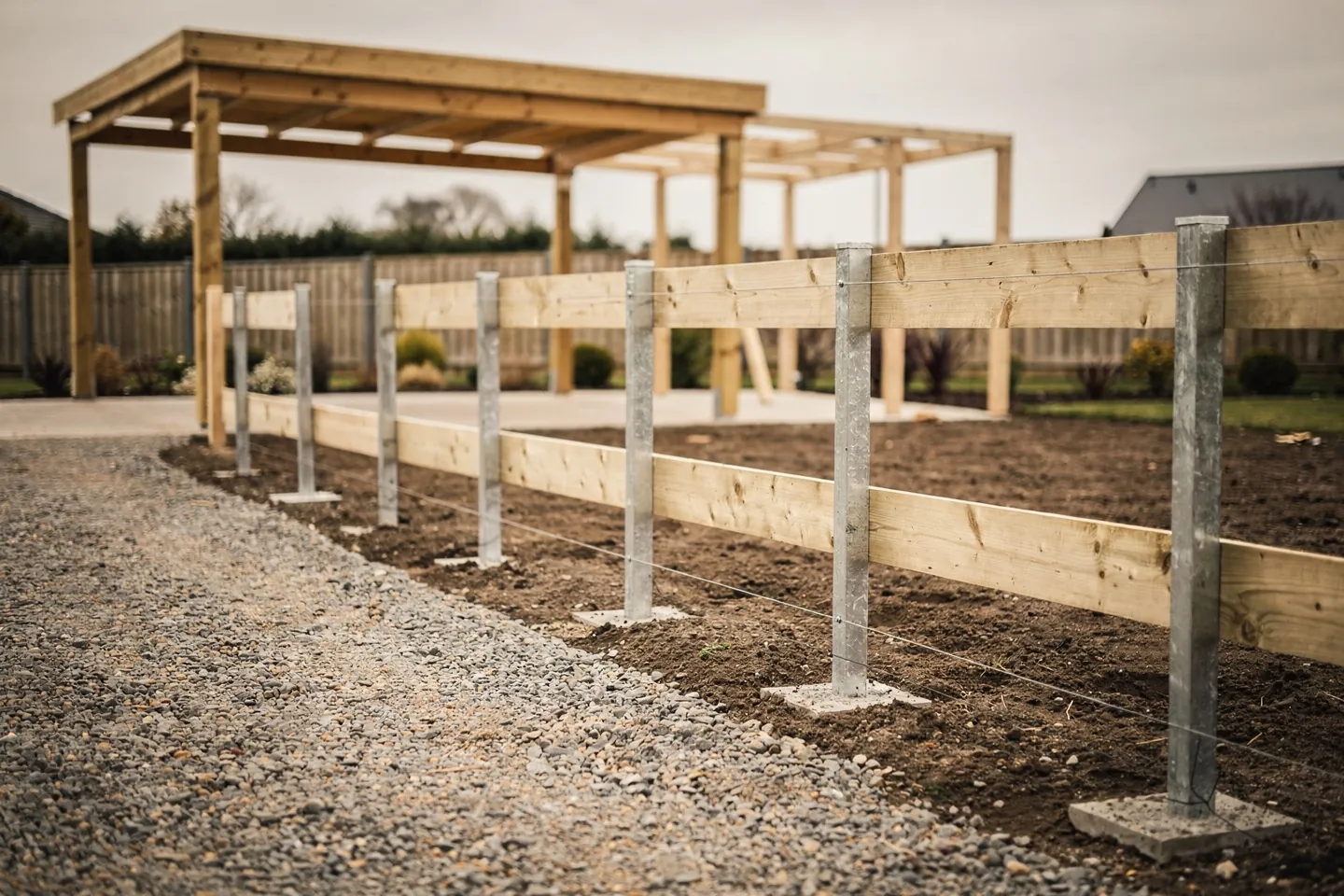
A fence is a minor structure if it is made of solid opaque materials up to 1.6 m high, or of light transparent materials up to 2 m, measured from the adjoining ground (§ 2 ods. 4 písm. d). It needs a notification only if a condition of § 18 ods. 3 applies. One of them is a structure on the builder's plot closer than 2 m to the plot boundary (písm. b), and a fence on the boundary line meets this condition by the wording of the act. Others are works on a public space (písm. a) and a heritage or protected area (písm. g).
A higher fence is no longer a minor structure, and § 18 ods. 2 applies. Repair of a fence and replacement of its parts without a change of route or size need neither a notification nor a permit (§ 18 ods. 5 písm. a bod 1).
The technical requirements come from decree 532/2002 Z. z., which stays in force until 31 March 2027 at the latest (act 25/2025, § 84 ods. 23). Under its § 12 ods. 2 a fence must not:
- by its extent, shape and material disturb the character of the building on the plot and of its surroundings,
- reach into the sight field of the connection of the building to a road,
- endanger the safety of road users and other persons.
How does the act classify a pergola, a pool and a retaining wall?
The act does not name a pergola. What decides is whether it is a structure at all, that is, whether it is fixed to the ground or its placement needs a prepared base (§ 2 ods. 1). If so, and it fits within 50 m² and 5 m, it matches the group of single-storey structures in § 2 ods. 4 písm. a), which are notified. Check how the office classifies your pergola.
The act lists a garden swimming pool among underground minor structures with a built-up area up to 25 m² and a depth up to 3 m (§ 2 ods. 4 písm. b). Such a pool is always notified (§ 18 ods. 3). A larger in-ground pool falls outside letter b), so expect building intent proceedings (§ 18 ods. 2). For an above-ground pool the definition of a structure in § 2 ods. 1 decides, and the act sets no separate limit for it.
A retaining wall up to 3 m above the lowest level of the adjoining ground is a simple building (§ 2 ods. 6 písm. e), not a minor structure. The notification regime of § 18 ods. 3 covers only minor structures and building alterations, so the wall needs a decision on the building intent (§ 18 ods. 2). The act has no separate threshold for low garden walls, so check their category before the design starts.
What applies to a driveway, paved areas and terrain modifications?
Building an entrance and paved areas up to 40 m² is an exterior alteration (vonkajšia úprava), one kind of building alteration (§ 2 ods. 9 písm. d). A driveway on your own plot is therefore notified only if a condition of § 18 ods. 3 applies, and otherwise needs nothing (§ 18 ods. 5 písm. k). Larger areas fall outside this definition, so check their category with the office.
The connection to the road is a separate matter. The road administrative authority decides on entrances from a road or local road to adjoining property, with regard to the protection of the road and traffic safety (act 135/1961 Zb., § 3b ods. 1). It decides on the opinion of the road administrator and of the traffic inspectorate (§ 3b ods. 4). If the entrance relates to a building in building intent proceedings, this decision is part of those proceedings and the road authority issues a binding opinion (§ 3b ods. 3). A crossing over a pavement is a minor structure (§ 2 ods. 4 písm. f), and works on a public space must be notified (§ 18 ods. 3 písm. a).
A terrain modification changes the relief of the ground, the physical properties of the subsoil or the drainage conditions (§ 2 ods. 9 písm. c). Raising or levelling a garden must be notified in particular when it comes closer than 2 m to the plot boundary (§ 18 ods. 3 písm. b), or when it can endanger stability or safety in use (písm. h).
How far from the boundary can I build and what rights does the neighbour have?
The 2 m distance in § 18 ods. 3 písm. b) triggers a notification. It is not a minimum setback distance. Setbacks are set by § 6 of decree 532/2002 Z. z. A structure may stand on the plot boundary only if it does not permanently limit the use of the neighbouring plot for its purpose (§ 6 ods. 2). The decree gives fixed figures, 7 m between houses and 2 m from the common boundary, only for family houses (§ 6 ods. 3). It gives no such value for a garage or shed, but distances must still meet general requirements, including daylight, sunlight, fire safety and maintenance of the buildings (§ 6 ods. 1).
Section 63 on notification names no parties to the procedure. But the office may find that the structure could affect the rights of third persons, or that conditions for carrying it out must be set. Then it tells the builder that the work may go ahead only on a decision on the building intent (§ 63 ods. 5).
Civil law applies as well. An owner must refrain from anything that would disturb a neighbour beyond a degree reasonable to the circumstances, including by shading. An owner must not endanger the neighbour's building or land by modifying the plot without adequate measures to secure them (act 40/1964 Zb., § 127 ods. 1). The cited version is in force until 30 June 2027, and Slov-Lex states that the Civil Code was repealed by act 260/2026 Z. z.
What changes for these structures from 1 January 2027?
Amendment 243/2026 Z. z. changes the Building Act from 1 January 2027 (Čl. XV). These changes matter for structures around a house:
| Topic | Until 31 December 2026 | From 1 January 2027 | Amendment 243/2026 |
|---|---|---|---|
| Fence as a minor structure | Opaque up to 1.6 m, transparent light materials up to 2 m | Up to 2 m from the adjoining ground, whatever the material | Čl. I bod 8 |
| Garage, carport, shed up to 50 m² and 5 m | Notification always | Notification only if a condition of § 18 ods. 3 applies, for example a building with a solid foundation or less than 2 m from the boundary | Čl. I body 7 and 59 |
| Condition of less than 2 m from the boundary | A structure or terrain modification | A structure or any building alteration, so also a driveway entrance | Čl. I bod 60 |
| Driveway entrance and paved area as an exterior alteration | Up to 40 m² | Up to 50 m² | Čl. I bod 24 |
| Underground structure from an assembled product | Minor structure up to 25 m² and 3 m deep | Notification up to 50 m² and 3 m deep | Čl. I bod 62 |
The amendment also introduces retrospective approval of works done from 1 April 2025 to 31 December 2026 without a verified project or against it, by a decision on the building intent (Čl. I bod 58). Under the new § 60 ods. 4 the office may approve afterwards two kinds of work. One is a minor structure under § 2 ods. 7 písm. d) to f) that is an accessory to a main building. The act names a garage and a shelter as examples, but they sit in písm. a), so the cross-reference is unclear. The other is an exterior or terrain alteration, in particular a fence or a paved area. The main building must be a simple building that counts as built in line with the rules under the previous regulations (Čl. I bod 129). An unnotified fence from that period may therefore have a route to put it right, but not an automatic one; a garage is unclear.