Why does mould appear after new windows and insulation?
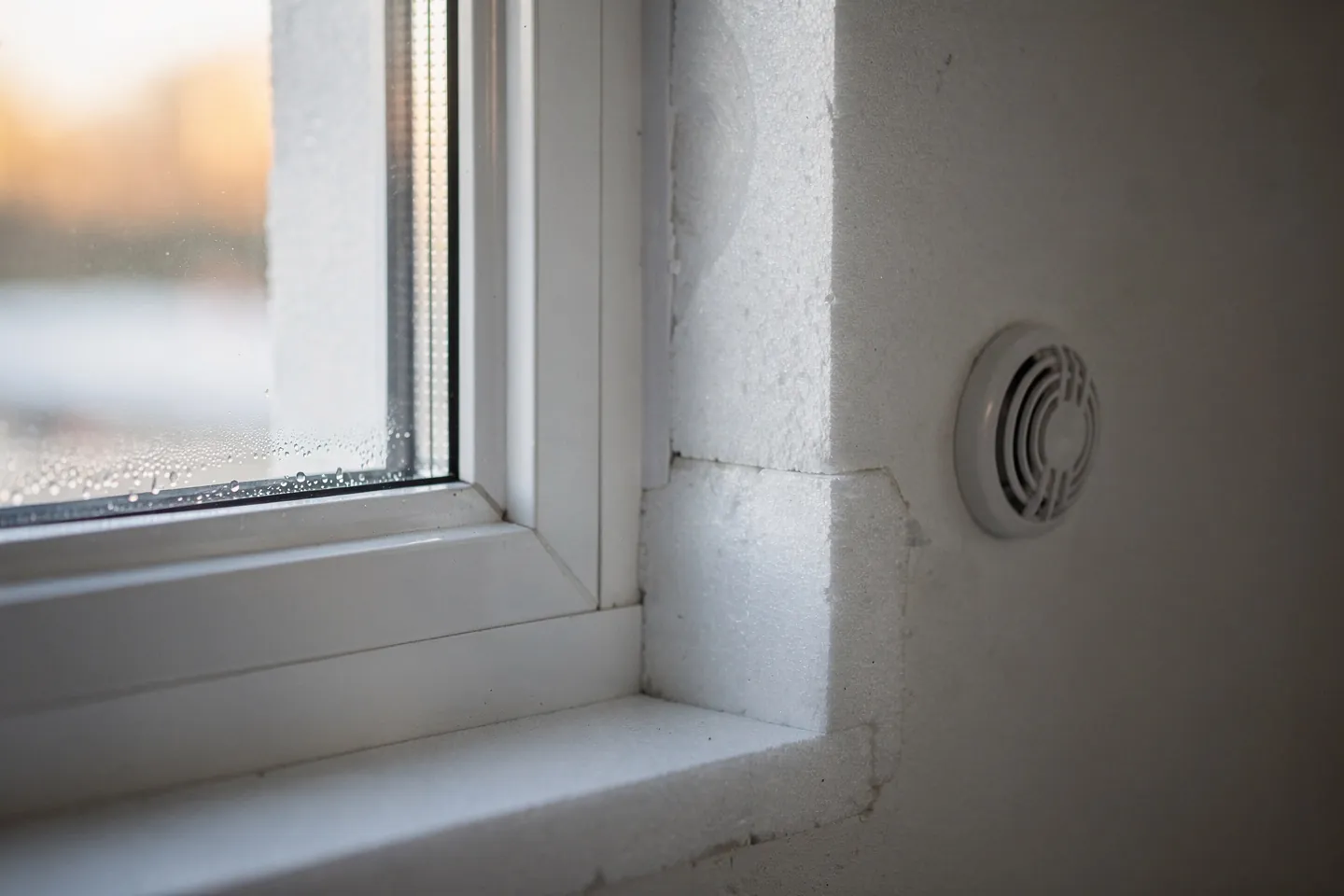
An old house with leaky windows ventilated itself. Outdoor air came in through the joint between the frame and the masonry and through the gap between the frame and the sash. This is called air infiltration, and SIEA names exactly these two places in its brochure on insulating family houses and replacing their windows. New windows close these paths. The moisture from cooking, showering, drying laundry and breathing then stays in the house.
SIEA describes the result directly. Sometimes an older house gets new windows before the walls are insulated. Then mould can appear after one or more winters, even in places where there never was any. With less air exchange, indoor humidity rises and mould appears at the thermal bridges. Correct external insulation that also covers the reveals, heads and sills raises the temperature of the inner wall surface. SIEA adds at once that the required ventilation rate must still be kept. A warmer wall lowers the mould growth risk, but it does not remove the moisture from the house.
The article Thermal bridges in a house renovation shows where the cold spots in an old house are and how to fit a window. This text covers the other half of the problem: how to get the moist air out of the house.
How much ventilation do Slovak regulations require?
The regulations say more about the need to ventilate than about the equipment to use. Decree 532/2002 Z. z. on general technical requirements for construction still applies after 1 April 2025. The building act 25/2025 Z. z. keeps it in force until the new implementing regulations take effect, at the latest until 31 March 2027 (§ 84(23)). The decree requires a building to meet the conditions for air exchange (§ 16(1)). It must also prevent moisture from building up in a structure or on its inner surface (§ 16(2)). A building is designed so that the indirect effects of moisture that cause mould growth do not endanger health (§ 16(5)). A room for longer stays must have direct or mechanical ventilation. The bathroom, the WC, the cooking area and the larder must be adequately ventilated (§ 17(4) and (5)).
Decree 259/2008 Z. z. on the indoor environment of buildings goes further. All indoor spaces where people stay must be ventilated, naturally or mechanically (§ 3(1)). Natural ventilation is used in spaces without sources of pollutants where an air change rate of one to two per hour is enough. The ventilation method and the size of the openings are set by calculation, and doors do not count as ventilation openings (§ 3(3)). Rooms with wet operations are ventilated under negative pressure (§ 3(16)). For living rooms the decree refers to a technical standard for the fresh air quantity per person (§ 3(10)). A footnote names STN EN 15251. Standards are sold for a fee, so we do not quote values from them.
The often quoted figure of 0.5 air changes per hour comes from Decree 364/2012 Z. z. on the energy performance of buildings. It is an input to the heating demand calculation, not a hygiene limit for ventilation. The calculation must include a minimum average air change in the building of 0.5 per hour. A higher value calculated to STN 73 0540-2 may replace it (Annex 3, note q). The input data for air flow and for losses by ventilation and infiltration come from STN EN 16798-5-1 (note t).
Decree 259/2008 also has a rule for the finished house. Walls, ceilings and floors of rooms where people stay must show no visible traces of mould, leaks or condensed water vapour. If they appear, they are removed by changing the structure or by changing the ventilation and heating (§ 2(11)).
What indoor humidity is acceptable in a house?
Three sources give three ranges of relative humidity. The Slovak decree sets permissible values, and two foreign agencies give recommendations for homes.
| Source | Relative humidity | Type of figure |
|---|---|---|
| Decree 259/2008 Z. z., Annex 2, Table 2b | 30 to 70 %, cold season | Permissible conditions under a Slovak regulation |
| Umweltbundesamt (Germany) | 40 to 60 % | Recommendation for flats and houses |
| US EPA (USA) | Below 60 %, ideally 30 to 50 % | Recommendation for homes |
The ranges do not match exactly, but they overlap. A value between 40 and 50 % meets all three. If a hygrometer shows higher values for long periods in winter, consider more ventilation or fewer moisture sources.
The humidity in the middle of a room does not show what happens in a cold corner, though. SIEA notes that a warmer inner surface prevents water vapour from condensing in cold room corners, but only with adequate and regular ventilation. Condensation is the warning sign. EPA treats condensation on windows, walls or pipes as a sign of high humidity and advises drying the surface quickly and reducing the moisture source. Measure humidity in winter in several rooms, especially in the bedroom in the morning and where mould has already appeared. This is our practical advice, not a regulation.
Which ventilation options suit a house that is lived in?
The options range from opening windows to a central unit with heat recovery. The table compares them by what matters most when renovating a house that people live in. We give no prices, because we have no source that compares them.
| Option | What controls the air exchange | Heat recovery | Work in a lived-in house |
|---|---|---|---|
| Purge ventilation through windows | The occupant | No | None |
| Window micro-ventilation | The occupant, through the handle position | No | Hardware with a gap ventilation position |
| Extract fan with air inlets | The fan, and humidity with humidity-controlled parts | No | Fan in the bathroom, WC and kitchen, air inlets in the living rooms |
| Decentralised unit | The unit's fan | Yes, regenerative exchanger | An opening through the outer wall in each ventilated room |
| Central heat recovery | The central unit | Yes | Ductwork to the rooms |
Purge ventilation through windows
Purge ventilation means opening a window wide for a short time. The German Umweltbundesamt (UBA) explains why it is needed more after a renovation. After an energy renovation the building envelope is tighter, the passive air exchange drops, and it must be replaced by more active ventilation. The most air is exchanged when windows on opposite facades are open at the same time. The weak point is that it depends on people. When nobody is at home during the day, nobody ventilates.
Window micro-ventilation
Some window hardware has a gap position in addition to the closed, turned and tilted positions. The operating instructions of the hardware maker MACO describe it as a position for longer airing at low outdoor temperatures. Such window micro-ventilation has neither a calculation nor a control behind it. For window ventilation, UBA notes that the effect depends on temperature and wind. Check in the quotation whether the new window has such a position before you order.
Extract fan and air inlets
An extract fan in the bathroom, WC and kitchen removes moist air where it is produced. This creates the negative pressure that Decree 259/2008 requires for wet rooms. Replacement air comes in through wall air inlets or inlets in the window frame in the living rooms. For humidity-controlled ventilation, the maker Aereco describes a mechanical sensor made of polyamide strips. The strips get longer and shorter with humidity and open shutters without electricity. The inlets go in the dry rooms and the exhaust units in the wet rooms. These are one maker's data for one system. This set-up does not return heat from the extracted air.
Decentralised units
A decentralised ventilation unit is fitted into an opening in the outer wall and ventilates one room without ducts. For its e² model, the maker LUNOS states the principle of regenerative heat exchange. It gives an air flow of 15–38 m³/h and a sound power level of 19–42 dB(A). The noise is made in the room itself, so for a bedroom ask for the figure at the air flow you will actually use. SIEA also mentions window systems with ventilation and heat recovery built into the window frame.
Central heat recovery
Heat recovery ventilation with a central unit supplies fresh air to the living rooms and extracts used air from the kitchen and bathrooms. This follows the rule in Decree 259/2008 that air flows from rooms with a cleaner environment to rooms with a less clean one (§ 3(4)). SIEA writes that as buildings become tighter, the need for controlled ventilation comes to the fore. It recommends considering heat recovery with local or central units. Decree 364/2012 requires heat recovery of at least 60 % efficiency in buildings with required airtightness and very low heat demand (Annex 3, note q). Ducts are hard to run in a lived-in house. We recommend considering a central unit mainly for a larger renovation that opens ceilings and floors. Design and commissioning are covered in the article Heat recovery in practice.
How do you renovate so that mould does not appear?
- Plan ventilation together with the windows. In its list of renovation steps, SIEA includes assessing controlled ventilation with heat recovery. For houses built to higher standards it also mentions a blower-door airtightness test.
- Measure humidity before and after the renovation. We recommend this so that you have a baseline if moisture appears in the first winter after the renovation.
- Check where the heat emitters are. Decree 259/2008 requires a placement that prevents water vapour condensation and mould. This applies to critical points on the inner surface of external structures (§ 3(21)).
- Deal with the wet rooms first. Under Decree 532/2002 the bathroom and the kitchen must be adequately ventilated, so we recommend starting with extraction there, even on a small budget.
- Let the designer choose the solution. Air flows and the positions of inlets and outlets come from a calculation, not from a seller's offer.
Do Obnov dom mini+ or Zelená domácnostiam pay for ventilation?
According to the documents read on 23 November 2026, no. The Obnov dom mini+ call with code 26-MFOD-V01 supports group A measures. These are insulation, replacement of windows and doors, insulation of the roof, the attic floor and the basement ceiling, and roof covering replacement. Group B covers energy sources: heat pumps, solar collectors, biomass boilers and heating controls. Ventilation and heat recovery are not on the list. The general conditions of Zelená domácnostiam II support photovoltaic panels, wind turbines, solar collectors, pellet boilers and heat pumps (part B, point 1).
So if a grant pays for the windows and the insulation, you pay for the ventilation yourself. Include it in the budget from the start. The programme conditions are explained in the Obnov dom mini+ grant guide.