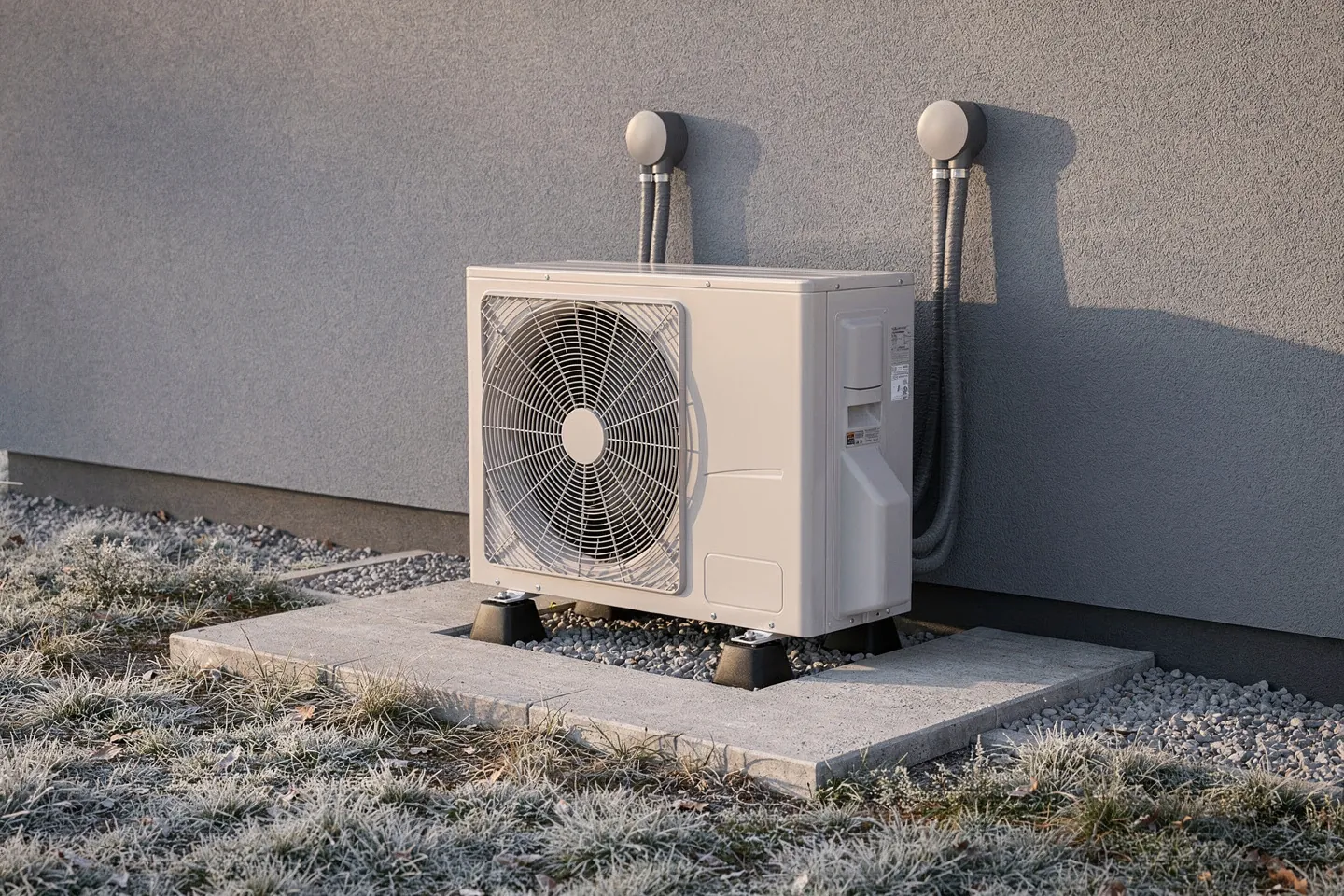
Monobloc or split: what is the difference for the house?
With an air-to-water heat pump, the first decision is the type. Regulation (EU) 2024/573 on fluorinated greenhouse gases uses two terms. A self-contained unit is a complete factory-made system in which the installer connects no gas-containing parts on site (Art. 3 point 38). A split system is several units connected by refrigerant piping. The installer installs and connects parts of the refrigerant circuit at the point of use (Art. 3 point 39).
For the house this means two different solutions. A monobloc keeps all its refrigerant outside and sends heating water into the house. A split sends refrigerant into the house and the water stays inside. With a monobloc, there is water outdoors that can freeze. The installation manual of one monobloc with R290 refrigerant states that the factory-fitted freeze protection valves protect the outdoor unit, not the field piping. More valves must go at all lowest points of the piping, and this manual forbids adding anti-freeze, for example glycol, to the water. With a split, the question is different: who may connect the refrigerant circuit.
| Aspect | Monobloc (self-contained) | Split |
|---|---|---|
| What runs between the unit and the house | Heating circuit water | Refrigerant piping |
| Refrigerant circuit connected on site | No, the installer connects no gas-containing parts on site (Art. 3 point 38) | Yes, the installer installs and connects the circuit at the point of use (Art. 3 point 39) |
| What to watch outdoors | Frozen water: freeze protection valves at the lowest points of the piping (manufacturer manual) | Only a certified person may install a circuit with fluorinated gas (Art. 10) |
| Ban on placing on the market up to 12 kW with fluorinated gas of GWP 150 or more | From 1 January 2027 (Annex IV point 8(b)) | From 1 January 2027 for air-to-water split (Annex IV point 9(b)) |
| Ban on placing on the market up to 12 kW with any fluorinated gas | From 1 January 2032 (Annex IV point 8(c)) | From 1 January 2035 (Annex IV point 9(d)) |
The bans under Art. 11(1) apply to placing products on the market, not to running a unit that is already installed. Each of them has an exception where safety requirements at the site of operation demand it.
Sound power or sound pressure: which number do you compare?
The energy label of a heat pump shows the sound power level. Regulation (EU) No 813/2013 defines it as the A-weighted sound power level, indoors and/or outdoors, expressed in dB (Art. 2 point 22). It is a property of the source. The sound pressure level is what a sound level meter reads at a given point, and it depends on distance, reflections and obstacles. So the neighbour hears pressure at their window, not the power on the label.
The same regulation sets a maximum outdoor sound power from 26 September 2015. It is 65 dB for heat pumps up to 6 kW rated heat output, and 70 dB above 6 kW up to 12 kW. LAI is the German federal and state working group on immission control. Its 2023 guide says that units well below 50 dB(A) sound power are on the market. It also warns that the label value is not always the maximum. If the manufacturer also gives a maximum value and night operation at that level cannot be ruled out, the assessment should use that value.
A catalogue sound pressure value holds only for the conditions of its test. The manufacturer manual warns that a measurement at the real site can show more than the catalogue value, because of ambient noise and sound reflections. When you compare offers, compare sound power and ask for its maximum value. A quiet night mode lowers noise, but according to the LAI guide it can also noticeably lower seasonal efficiency.
How much noise may reach the neighbour's window?
In Slovakia, decree No 549/2007 Coll. of the Ministry of Health applies. The space in front of the windows of living rooms in family houses is area category II (Annex, Table 1). The same category covers outdoor space in residential and recreational areas. For noise from sources other than transport, the permitted equivalent level is 50 dB by day and in the evening, and 45 dB at night. Day runs from 6:00 to 18:00, evening from 18:00 to 22:00 and night from 22:00 to 6:00. The measuring point in front of an external wall lies 1.5 m ± 0.5 m from the wall. It lies 1.5 m ± 0.2 m above the floor of that storey (§ 6(3)(b)).
For tonal or especially disturbing noise, the assessment adds a correction of +5 dB to the equivalent level (Table 2). The decree gives the intermittent running of a compressor as an example of intermittent noise. It describes tonal noise as sound to which a listener can subjectively assign a pitch. So the night limit at the neighbour's window is what decides. The post on acoustics in a family house explains how the decree treats noise inside the house.
How do walls, corners and distance change what the neighbour hears?
The LAI guide is German and its limits are German, but sound travels the same way everywhere. Its emission level of a unit starts from the sound power. It subtracts the effect of a blocked line of sight and adds the effect of reflections and tonal components. A table then gives the minimum distance to the neighbour's window from that level: the higher the level, the further away the unit must stand.
| Situation at the unit | Adjustment to the emission level (LAI) |
|---|---|
| No reflecting surface closer than 3 m (for example in the garden) | 0 dB |
| One reflecting surface closer than 3 m (in front of a house wall) | +3 dB |
| Two reflecting surfaces closer than 3 m or at most 5 m apart (corner, between two walls, under a canopy) | +6 dB |
| Direct line of sight to the neighbour's window | 0 dB |
| Indirect line of sight | −5 dB |
| No line of sight, for example blocked by a building | −15 dB |
| Tones perceptible, or clearly audible (if nothing is known, use 3 dB) | +3 dB, or +6 dB |
A corner between two walls therefore adds 6 dB, the same as a unit with 6 dB more sound power. A screen works only if it stands as close to the source as possible and is larger than the source. If it blocks the line of sight and stands right next to the source, it lowers the rating level by about 10 dB. Next to a house wall, though, a screen can cause multiple reflections, so its side facing the unit gets an absorbing lining. Neither a screen nor an enclosure may restrict airflow to the heat exchanger, or the unit loses capacity and its noise can rise.
Where should the outdoor unit stand, and on what?
The LAI guide says the unit, its air inlet and its outlet should stand far from the neighbour's protected spots. Ideally they face away from them. The guide adds that a position towards the street often makes sense, because bedrooms and terraces usually face away from the street. The manufacturer manual forbids placing the unit near noise-sensitive areas, for example a bedroom, and in a basement. In a place exposed to wind, the air inlet and outlet should be perpendicular to the main wind direction, with wind protection if needed.
The base under the unit matters. The LAI guide advises against hard surfaces such as concrete, tiles or asphalt and prefers a gravel bed, grass or bark mulch. The guide says to decouple unit and ground acoustically. One way is an elastic bearing of the concrete slab on rubber feet, with no rigid bridges such as bolted joints. The unit should not stand on a floating screed with impact sound insulation, and a joint around its base should separate it. Pipes should hang on elastic supports, not in rigid clamps. One monobloc manual requires at least 150 mm of free space under the unit and at least 100 mm above the highest expected snow level.
Choose the spot while laying out the plan. Put the plant room close to the unit, keep the piping short, keep the unit away from bedroom windows and leave room for service. The distance from the plot boundary follows from sound power, reflections and the position of the neighbour's windows, not from one set number.
What happens to ice and condensate during defrosting?
The heat exchanger of the outdoor unit ices up in winter, so the unit regularly runs a defrost cycle. The LAI guide says that icing and automatic defrosting usually cause disturbing sounds different from normal running. In some units this happens regularly at outdoor temperatures below 10 °C.
Defrosting releases water. The manufacturer manual requires that condensate can drain away properly. In a cold climate it recommends insulating the drain hose and adding a drain heater so that the condensate cannot freeze. The drain hole in the bottom plate must not be covered. Plan at the design stage where the drain leads, so that the condensate does not freeze on a path or step.
What protective zone does a unit with R290 refrigerant need?
R290 is propane. Regulation 2024/573 gives it a GWP of 0.02 in Annex VI. The manufacturer manual places it in safety class A3 as defined in ISO 817 and used in EN 378. So a protective zone applies around the outdoor unit in case of an unlikely leak. According to this manual, the zone must not contain:
- openings into habitable areas: openable windows, doors, ventilation openings, basement entrances.
- ignition sources, even brief ones: open flames, electrical installations, sockets, lamps, switches, the electrical house connection, sparking tools and surfaces hotter than 360 °C.
- adjacent buildings and public traffic areas, which the zone must not reach.
- units of another type, with another refrigerant or from another manufacturer.
The shape and size of the zone depend on the installation, for example in front of a wall, in a corner or on a roof. The manufacturer gives them for each model. So an R290 unit cannot be moved closer to a window without checking the zone. With a house close to the boundary, the zone can decide the position before noise does.
What should you ask the installer before signing?
- What is the outdoor sound power level on the label, and what is the maximum value, especially at night?
- Does the unit have tonal components or marked low-frequency noise?
- Which refrigerant does the unit use, and what protective zone does the manual give?
- For a split: who connects the refrigerant circuit, and do they hold a certificate under Art. 10 of Regulation 2024/573?
- For a monobloc: where will the freeze protection valves go, and how is the outdoor piping insulated?
- Where will the condensate go, and does the drain have a heater?
- What base will the unit stand on, and with what elastic bearing?
Check noise and the protective zone at the design stage. The unit is part of the whole energy concept in the passive house guide. If the neighbour's bedroom lies close to the boundary, a specialist can calculate the level at their window as part of a noise study.