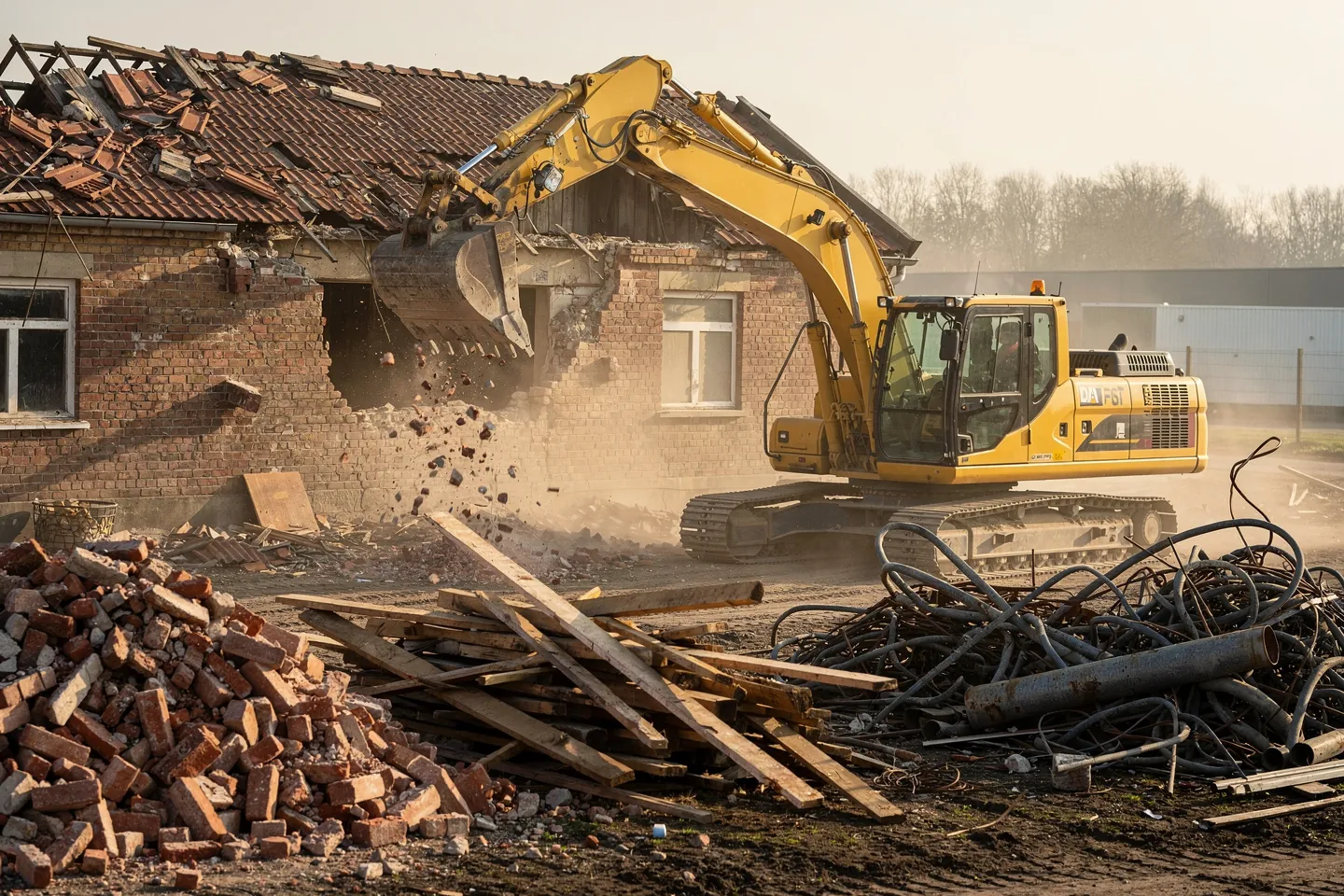
What permission do you need to demolish a house?
A decision on the building intent and a verified project. Since 1 April 2025 the Building Act, No. 25/2025 Z. z., has no separate "demolition permit". Removal of a structure includes handling the waste, and removal in full means demolishing every structural element (§ 2 ods. 11).
Unless the act says otherwise, removal of a structure requires a decision on the building intent (§ 18 ods. 2). Demolition may only follow a project verified in that procedure or a notification (§ 25). The old name and its current form are explained under demolition of a structure. Whether to demolish at all is covered in renovate or demolish.
When is a notification enough and when do you need a decision?
An ordinary family house falls into the first row.
| Case | What the act requires | Provision |
|---|---|---|
| A family house and any other structure not covered by an exception | A decision on the building intent, then verification of the project | § 18 ods. 2, § 25, § 65 |
| A structure built on a notification, an information structure, an assembled product | The owner notifies the office of the period within which the structure will be removed | § 63 ods. 11 |
| A minor structure with a registration number (súpisné číslo) | Notification | § 18 ods. 3 písm. c |
| An accident or natural disaster that threatens life or serious damage | Demolition may start without a building intent, and the office must be told without delay | § 47 ods. 1 |
| A structure built by unauthorised works | The building inspectorate orders the removal and sets a deadline | § 78 |
For other minor structures the conditions of § 18 ods. 3 and 5 decide, for example a location in a heritage area (ods. 3 písm. g). Act No. 243/2026 Z. z. also amends § 18 ods. 2 from 1 January 2027 (Art. I point 58), so read the wording in force on the day you file.
What documents does the application need?
The builder files the application electronically on the prescribed form. It comes with project documentation from an authorised person and the report on the consultation of the building intent (§ 50 ods. 1 and 2). The building intent can express the removal of a structure (§ 9 ods. 2). The building project expresses the removal in text and drawings (§ 9 ods. 3). If a designer did not prepare the intent, the office rejects the application (§ 59 ods. 1 písm. b). The content of the project is covered under demolition project documentation.
Before filing, the builder or designer makes the documentation available in the information system. They ask the spatial planning authority and the affected authorities for binding opinions. They ask the affected legal persons for binding statements (§ 20 ods. 1). The office then asks whether the applicant holds a right to the structure that allows the works (§ 57 ods. 2 písm. a). So have a current land registry extract ready. If the house stands on the plot boundary or shares a wall with a neighbour, also commission a structural assessment of what will remain standing after demolition.
How does demolishing a house work, step by step?
The periods are statutory periods for offices and firms, not an estimate of how long the demolition takes.
| Step | Who | What and by when | Provision |
|---|---|---|---|
| Asbestos identification | The demolition firm, with the owner | Before work in premises built before 1 January 2005 | Government regulation 185/2026 § 8 ods. 1 |
| Building intent and project | Designer | Both the intent and the project express the removal | § 9 ods. 2 and 3 |
| Opinions and statements | Affected authorities, network operators | Opinion or statement within 30 days, within 60 days for complex structures | § 21 ods. 9, § 22 ods. 5 |
| Decision on the building intent | Building office | 30 days, 60 days with a hearing or inspection, 90 days in the cases of § 58 ods. 2 | § 58 |
| Project verification | Building office | 30 days, or together with the decision | § 65 ods. 2 |
| Notice of asbestos removal | Authorised firm | No later than 30 days before work starts | 355/2007 § 41 ods. 13 |
| Demolition notice | Waste producer | No later than three working days before, to the waste authority | 79/2015 § 77 ods. 3 písm. e |
| Demolition | Authorised contractor | According to the verified project, asbestos before other work | § 25, § 26, Government regulation 185/2026 § 8 ods. 6 |
| Report on selective demolition | Waste producer | No later than 90 days after the works end | 79/2015 § 77 ods. 3 písm. f |
| Deletion from the cadastre | Owner | Municipal confirmation that the structure was removed | 162/1995 § 46 ods. 8 |
Who may demolish a house?
The builder must have the work done by an authorised contractor unless the builder holds the authorisation (§ 26 ods. 2). A contractor is a person authorised to build or remove structures commercially (§ 31 ods. 1). A builder may also remove a simple structure by self-build if a person authorised for construction supervision leads the work (§ 26 ods. 3 and 5). A simple structure is, for example, a residential building with at most three flats. Its built-up area is up to 300 m² and it has at most two above-ground storeys (§ 2 ods. 6 písm. a).
Self-build has limits. Only a business or legal person authorised by the public health authority may remove asbestos from a structure (Act No. 355/2007 Z. z., § 41 ods. 1).
How do you disconnect the house from utilities?
The owners and operators of technical networks, meaning water, electricity, gas, sewerage and electronic communications (§ 4 ods. 2), are affected legal persons in the procedure (§ 22 ods. 1 písm. a). On request of the builder or designer they issue a binding statement with specific requirements for the project (§ 22 ods. 3). They have 30 days, at most 60 days for complex structures. If they issue nothing in time, they are presumed to have no requirements (§ 22 ods. 5).
Agree the disconnection of connections and meters with the network operator before work starts, and ask well in advance. If you plan a new house, agree at the same time whether any connection can stay.
What about asbestos cement and other hazardous materials?
Before demolition in premises built before 1 January 2005, the employer must identify materials likely to contain asbestos, including with information from the owner. If information is missing, the employer has the materials examined in a provable way (Government Regulation No. 185/2026 Z. z., § 8 ods. 1). Before demolition the employer draws up a work plan. Asbestos is removed before demolition starts unless that would put workers at greater risk (§ 8 ods. 5 and 6 písm. a). On older houses it is often asbestos cement in roofing or cladding.
Only an authorised firm may remove asbestos. It must notify the public health authority of each removal at least 30 days in advance (Act No. 355/2007 Z. z., § 41 ods. 1 and 13). A natural person may not handle construction waste containing asbestos from simple or minor structures (Act No. 79/2015 Z. z., § 12 ods. 6), and hazardous waste may not be mixed with other waste (§ 25 ods. 1). Authorisations and air testing are covered in asbestos and old services in a renovation.
What happens to the demolition waste?
When the work is done for a natural person, the waste producer is whoever does the work, usually the demolition firm (Act No. 79/2015 Z. z., § 77 ods. 2). It must carry out selective demolition. This means it sets the order of work so that materials can be separated and sorted (§ 77 ods. 1 písm. b, ods. 3 písm. b). Before the waste arises it must hold a contract for its physical handling (ods. 3 písm. d). On structures over 300 m² of built-up area it must prepare for reuse, recycle or recover at least 70% of the waste by weight in a calendar year. The target covers group 17 of the catalogue. It excludes hazardous waste and soil and stones under number 17 05 04 (Annex 3 part VI point 2).
The order is set by the waste hierarchy: prevention, preparing for reuse, recycling, other recovery and only then disposal (§ 6 ods. 1). Whole bricks and roof tiles can be prepared for reuse, see building deconstruction. A wider view is under construction and demolition waste. The catalogue numbers in the table come from Decree No. 365/2015 Z. z.
| Fraction | Catalogue number | Category | Counts towards the 70% target | What to do with it |
|---|---|---|---|---|
| Concrete | 17 01 01 | other (non-hazardous) | yes | Separately, for recycling |
| Bricks | 17 01 02 | other (non-hazardous) | yes | Whole pieces for reuse, the rest for recycling |
| Tiles, cladding and ceramics | 17 01 03 | other (non-hazardous) | yes | Reuse whole roof tiles, recycle the rest |
| Wood | 17 02 01 | other (non-hazardous) | yes | Reuse suitable beams and boards, recover the rest |
| Iron and steel | 17 04 05 | other (non-hazardous) | yes | Separately as scrap metal for recycling |
| Soil and stones | 17 05 04 | other (non-hazardous) | no | Outside the target, agree its use with the contractor |
| Construction materials containing asbestos | 17 06 05 | hazardous | no | Separately, in closed packaging, only to an authorised person |
| Mixed construction waste | 17 09 04 | other (non-hazardous) | yes | Keep the share low, sorting after demolition is harder |
What about the neighbours?
The owner of a neighbouring structure or plot is a party to the building intent procedure if the decision may directly affect their property rights (§ 49 ods. 1 písm. c). The office tells the parties about the start of the procedure within seven days of the day the application is complete (§ 51 ods. 1).
If cramped conditions allow demolition only from the neighbouring plot, the office may order the neighbour in the decision to tolerate the work for the necessary time and to the necessary extent. The builder must then announce the work in advance and disturb the neighbour as little as possible. Afterwards the builder restores the plot. If that is not possible, the builder compensates the damage (§ 46). It pays to talk to the neighbours before the office does: dust, noise and vibration are what they will remember. Photograph the state of neighbouring walls and fences before demolition.
What happens to the cadastre entry?
A demolished house has to be removed from the cadastre. This requires two things. One is a document under § 2c of the Municipalities Act, which governs building numbers. The other is a municipal confirmation that the structure was removed. If the structure had no registration number, the municipal confirmation is enough (Act No. 162/1995 Z. z., § 46 ods. 8). The municipality cancels the registration number (Act No. 369/1990 Zb., § 2c ods. 1). Owners must report changes in the data to the district office within 30 days. Natural persons are exempt for data from documents (Act No. 162/1995 Z. z., § 19 písm. a).
No kolaudácia follows a demolition. The act requires it for a new structure, a change of a completed structure and terrain works that needed a decision (§ 66 ods. 1). A new house on the plot is a new building intent procedure.