A house from the 1960s to the 1980s usually has sound masonry and a sensible layout. Behind the plaster and under the roof covering, though, it carries a layer you cannot see on a viewing: asbestos-cement products, aluminium wiring, galvanised steel water pipes and old gas lines. None of this is a reason to demolish the house. It is, however, an item that has to be named before anyone starts cutting, otherwise an ordinary renovation turns into a problem with health, with the authorities and with the budget. If you are still weighing whether to keep the house at all, start with renovate or demolish. Here I assume the decision has been made and look at what is in the house and in what order to get rid of it.
What does a Slovak house from the 1960s to 1980s hide?
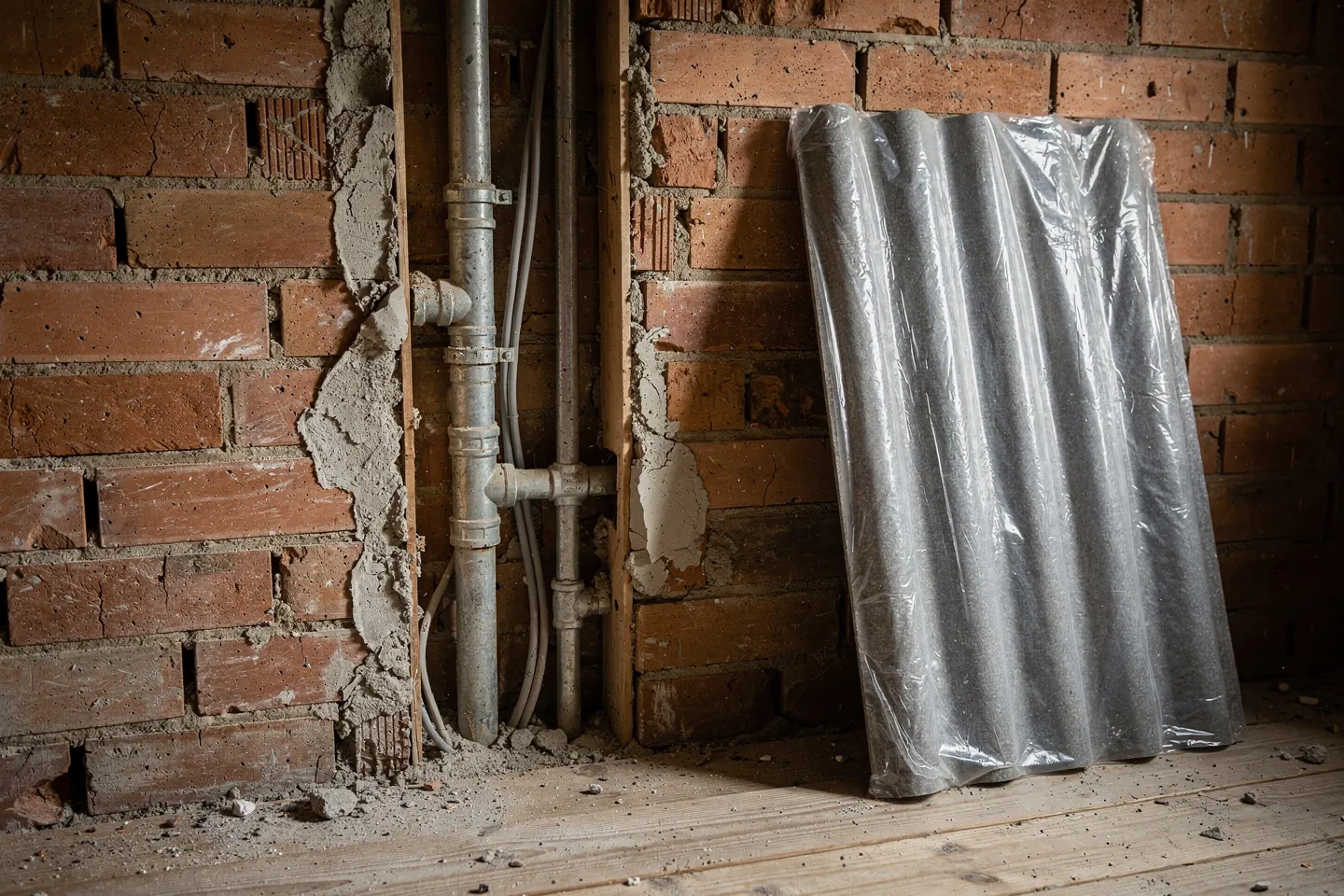
Asbestos cement, known colloquially as eternit, was cheap, light and non-combustible at the time, so it was used wherever something needed covering or draining. These are the typical places:
- Roof and facade: corrugated sheets on garages and outbuildings, slates on pitched roofs, cladding boards on gables and soffits.
- Chimneys and flues: asbestos-cement pipes inserted into the flue as a retrofit lining or carried above the roof. Today a new chimney liner replaces them when the boiler is changed.
- Water and drainage: waste stacks, drain vent pipes, sometimes a section of the buried water connection.
- Interior: insulating boards behind tiled stoves and next to boilers, fire-protection linings, some floor tiles and the adhesives beneath them.
Add to that aluminium wiring, galvanised steel water pipes, cast-iron drains and gas pipework that often dates back to the original connection. Each of these carries a different risk and calls for a different procedure.
Why is intact asbestos cement no cause for alarm, but cutting it is?
Asbestos is among the substances the International Agency for Research on Cancer classifies as carcinogenic to humans. The danger lies in its fibres once they become airborne and are inhaled. The diseases it causes appear many years after exposure, and public health authorities state that there is no safe level of exposure.
In asbestos cement the fibres are firmly bound by cement. As long as a sheet is whole and undamaged, it releases very little. What matters is what you do with the material. An angle grinder, a drill, breaking sheets while throwing them off a roof or a pressure washer on weathered roofing release fibres exactly where a person stands without protection. So I separate two situations: material that stays in place and nobody touches, and material that is in the way of planned work. The second kind is removed before anyone else arrives.
| Material | Where it hides | If left intact | If disturbed | Who removes it |
|---|---|---|---|---|
| Corrugated and flat asbestos-cement sheets | garage roofs, outbuildings, gables | low risk, surface weathering | high when broken, cut or cleaned | firm authorised by the Public Health Authority (ÚVZ SR) |
| Asbestos-cement flue pipes | chimney flue, flue run above the roof | low, if the chimney is not reused for a new boiler | high when pulled out or when the chimney is broken up | firm authorised by ÚVZ SR |
| Asbestos-cement drain and water pipes | stacks, drain vents, buried connection | low in the ground and in an intact stack | high when cut and smashed | firm authorised by ÚVZ SR |
| Insulating and fire-protection boards | behind tiled stoves, near the boiler, in the boiler room | medium, the material is often softer and crumbles | high, fibres are released easily | authorised firm, with measurement after the work |
| Floor tiles and adhesives | kitchens, corridors, under newer floors | low under a covering layer | medium to high when sanded or chipped off | sample analysis, then an authorised firm |
Today's fibre-cement products, such as fibre-cement facade cladding, contain no asbestos. Its use has been banned in the European Union since 2005, so the question only concerns older materials. Whether a sheet contains asbestos is decided by laboratory analysis of a sample, not by guessing from its appearance.
How does asbestos removal work in Slovakia?
Removal of asbestos-containing materials is governed by the Act on the Protection, Support and Development of Public Health (355/2007 Z. z.) and related regulations on protecting workers. Pulling eternit off the roof yourself is not a legal saving, it is a breach of the rules. The procedure, as a regional public health authority describes it, has four steps:
- The owner orders a firm that holds an authorisation from the Public Health Authority of the Slovak Republic (ÚVZ SR). The authority publishes the list of authorised firms.
- The firm applies to the competent regional public health authority (RÚVZ) for a decision covering the specific work. For interior work, a typical condition is measuring the concentration of asbestos fibres in the air after dismantling.
- Before starting, the firm notifies the authority that work is beginning, and after finishing it notifies completion.
- The waste is wrapped, labelled and handed over as hazardous waste to an authorised operator. It does not belong in the skip with the rubble.
Processing times and fees vary by authority and scope, so confirm them directly with the RÚVZ or with the firm submitting the application. Put proof of waste handover into the contract. A suspiciously low price often means the waste ends up somewhere it should not.
Aluminium wiring: why it is replaced whole
Aluminium went into domestic wiring because copper was scarce. The problem is not the conductor itself but the joints. Under the pressure of a terminal, aluminium slowly creeps, the surface oxidises and contact resistance rises. The joint heats up, the terminal loosens and the cycle repeats. After decades the conductors are brittle and snap when bent inside a junction box.
On top of that come the properties of the installation as a whole: no separate protective conductor, few circuits for the entire house, no residual current device and a fuse board with no spare capacity for an induction hob, a heat pump or car charging. A partial replacement, where new copper conductors are joined to old aluminium ones, only moves the problem into the junction boxes inside the walls.
That is why the wiring in such a house is replaced whole: a new distribution board, new circuits, copper conductors, residual current devices and earthing. At the end comes the inspection and test carried out by a licensed electrical inspector, who issues an inspection report (revízna správa). Without it the distribution company will not raise your reserved capacity, and after a fire the insurer may ask for exactly this document. Have the original installation inspected before the design as well: it tells you what lies under the plaster and which circuits are live during demolition.
Water, drainage and gas: what to replace and what to keep?
Galvanised steel corrodes from the inside and scales up. Pressure drops, the water runs rusty after the night and threaded joints start leaking in random order. Lead pipes are rare in Slovak family houses; they are more likely in older town houses or on a section of the service connection. You recognise them by a soft grey metal that shines when scratched and by joints without threads. Lead leaches into water and has no place in drinking water, so there is nothing to discuss here. Cast-iron drainage, on the other hand, is often in better condition than it looks, especially the vertical stacks.
| Old installation | Typical condition | Replace or keep? | What decides |
|---|---|---|---|
| Aluminium wiring | brittle conductors, loose joints, no protective conductor | replace whole | inspection report on the existing state, electrical design |
| Galvanised steel water pipes | narrowed bore, rust, leaking threads | replace whole | almost always during a renovation |
| Lead pipes | rare, soft metal without threads | replace without exception | identification, possibly a water test |
| Cast-iron stack | often working, noise and corroded sockets | sometimes keep | inspection, camera, new connection points |
| Horizontal drains under the floor | cracks, roots, altered falls | depending on findings | camera survey before new floors |
| Old gas pipework | threaded steel, old shut-off valves | rework or decommission | new heat source, gas design and inspection |
With gas a simple rule applies: every intervention goes through a design and an inspection by a licensed technician, not through a plumber with a wrench. If a deep renovation moves you to a heat pump, consider whether you need gas in the house at all. Ending the supply and possibly removing the connection are arranged with the distribution operator and take their own time.
In what order: survey, remediation, only then chases
The general order of work is covered in house renovation: the order of steps. For hazardous materials and services it implies a narrower sequence:
- Survey. Samples of suspect materials for analysis, inspection of the existing wiring and gas, a camera survey of the drains. The results go into the design, not into a drawer.
- Design. New service routes, the distribution board, connections and the extent of demolition, including what stays untouched.
- Asbestos removal. The authorised firm works first and alone. Indoors, other trades go in only after a measurement confirms acceptable indoor air quality.
- Disconnection and strip-out. Old services are disconnected, dismantled and sorted.
- Chases and new services. Only now does anyone cut into the masonry. Chases are made good with lime plaster, which suits old brick masonry, and the surface can also take a clay plaster.
- Tests and inspections. Water pressure test, electrical and gas inspection, then finishes.
The most common mistake is the reverse order: the electrician cuts chases through a wall with an asbestos board behind it, or the demolition crew strips the roof before anyone has checked the covering. The site then stops until the situation is resolved, and the following trades wait.
What does this do to the renovation and new-build budget?
Asbestos is not an argument for demolishing the house. Demolition requires its removal too, and all of it, including parts that could stay undisturbed in a renovation. Removal is a separate item that depends on area, access and the quantity of waste, and it belongs in the comparison of both routes equally.
The same goes for services. You pay for new wiring, water and gas in both scenarios. The difference lies in the work around them: in a renovation you cut into existing walls and make good the surfaces, in a new build the services run into finished openings. That extra work is real, but rarely decisive.
There is also an argument for a careful procedure. Until hazardous materials are separated, the rest of the house cannot be sorted sensibly. Bricks, timber and metal from the house can become secondary raw materials and the house a material bank in the sense of urban mining, but only if the asbestos is removed first and separately. Mixed construction and demolition waste with asbestos fragments can no longer be recycled, and the whole lot turns into a more expensive problem.
In practice: in the renovation budget, keep asbestos removal and the replacement of services as separate lines priced from a quote, not as part of the contingency. The contingency is for what you find. These you know in advance.