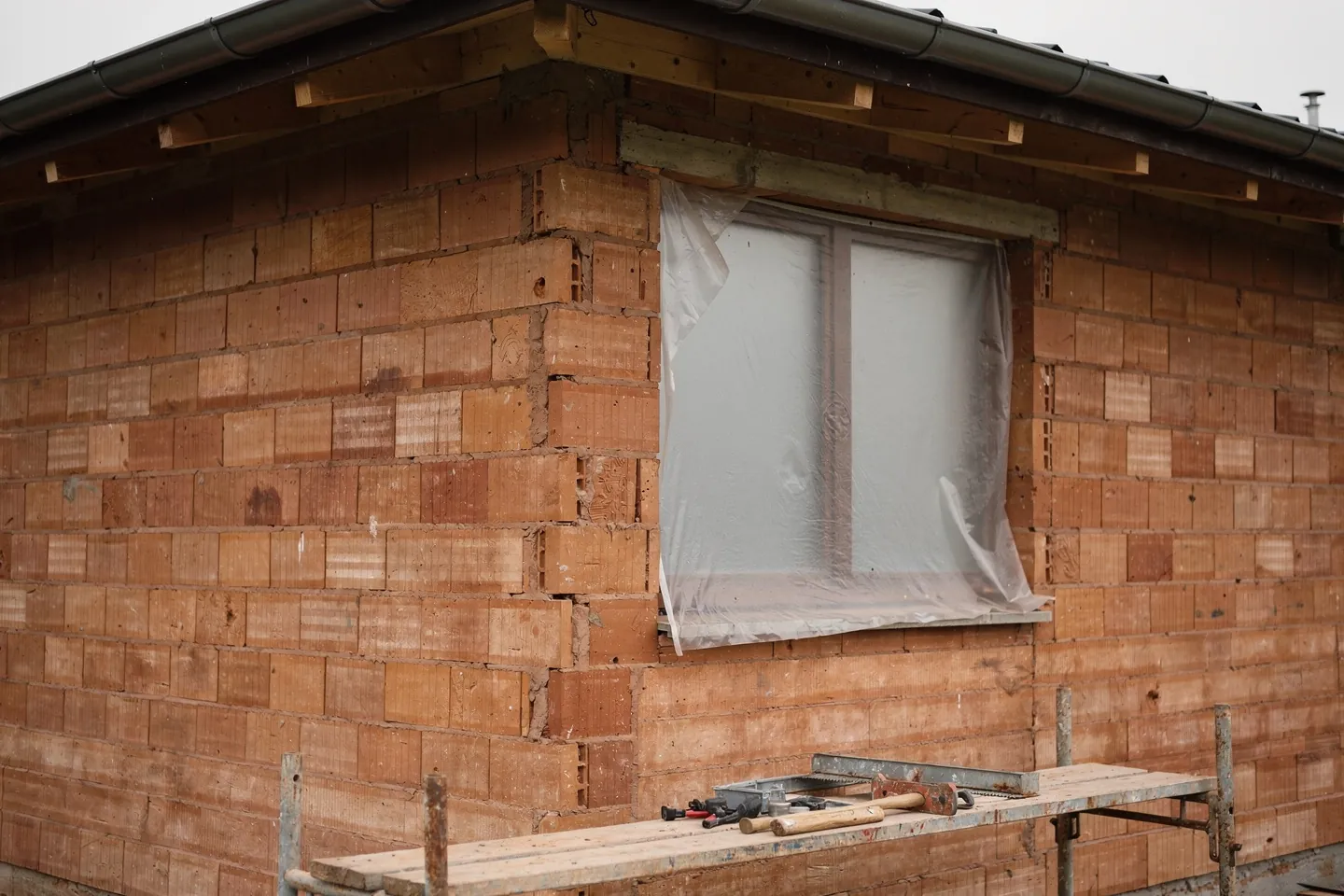
When a client shows me two offers for their future house, one of them is almost always noticeably cheaper. The first reaction is delight, the second is suspicion. On closer reading it usually turns out that the cheaper firm priced a "holodom" (a shell with services but no finishes) and the more expensive one priced a "turnkey" house. Or both wrote "turnkey" and each meant something different. The price gap is then not a gap in efficiency, but in what you are actually buying for your money.
This article is not about prices. Why the price per square metre is a treacherous figure is covered in the piece on what a house costs per m2. Here the question is the one that should come first: what exactly sits behind the terms shell, holodom and turnkey, what they usually leave out, and how to get it on paper before you sign a contract.
Is there a binding definition of holodom in Slovakia?
No. No act and no technical standard sets out what a shell, a holodom or a turnkey house must contain. They are commercial terms, and every builder, catalogue-house seller and developer reads them in their own way. The Building Act (25/2025 Coll.) deals with permitting, construction and use of buildings, not with where one firm's delivery ends. The STN standards describe how structures are designed and built, not what the word holodom should mean.
That leaves one practical rule: the contract schedule that lists the scope of work item by item decides. Not the package name, not the brochure and not the rendering on the website. If an offer contains only the word "holodom" and a single sum, you do not hold an offer. You hold a heading.
What do a shell, a holodom and a turnkey house usually include?
The table shows how these terms are most often used in practice. Treat it as a basis for a conversation with the builder, not as a definition you can later rely on.
| Delivery stage | What it usually includes | What is usually missing | Where it gets vague |
|---|---|---|---|
| Shell (open) | Foundations, load-bearing and external walls, floor slabs, staircase, roof structure | Roof covering, windows, doors, services, plaster | Earthworks, substructure insulation, chimney, internal partitions |
| Weathertight shell | Shell plus roof covering, flashings, windows and entrance door | Services, internal plaster, screeds, facade | Window type and installation, roof insulation, garage door |
| Holodom | Weathertight shell plus water, drainage, electrical and heating distribution, plaster, screeds, often the facade | Floor finishes, tiling, sanitary ware, internal doors, painting | Heat source, facade, sills, distribution board, ventilation |
| Turnkey | Holodom plus floors, tiling, sanitary ware, internal doors, painting, heat source | Kitchen, lighting, utility connections, landscaping, fencing, fees | Finish standard and what "ready to live in" actually means |
Most disputes arise over holodom. One firm counts the facade, the heat source and internal sills in, another stops at plaster and screeds. The difference between those two readings is a whole construction stage. If you receive two offers for a holodom, the first step is not to compare the sums but to lay the scopes side by side.
When stopping at holodom makes sense
People choose holodom most often when they want to do the finishing themselves or with their own tradespeople. That is sensible if you have the time, the experience and someone to coordinate the order of work. The risk lies at the interface: who is responsible for the screed being flat enough for large-format tiles, or for the water outlets matching a kitchen you only chose later? If the contract does not name it, a defect easily turns into a dispute about whose problem it is. When the delivery is split, the state in which the firm hands the building over must be described precisely, including tolerances and prepared outlets.
What is most often missing from a turnkey price?
The word turnkey suggests a house you can carry your suitcases into. In reality the delivery boundary stops sooner than you would expect even at this stage. These items are most often missing from turnkey offers:
| Item | Why it is usually excluded | What to ask |
|---|---|---|
| Utility connections for water, sewer, electricity, gas | They depend on the plot and the distance to the networks, not on the house | Who builds them and who arranges the contracts with the network operators |
| Landscaping and paved areas | The extent only becomes clear once the building is finished | Are backfill, rough grading and a path to the entrance included? |
| Fencing and gate | A separate package, often another firm | Who provides at least the site hoarding during construction? |
| Kitchen and built-in furniture | Individual choice and a separate supplier | Are services and outlets prepared for the specific kitchen? |
| Sanitary ware and taps | The firm assumes a basic range or a price allowance | Which specific product, or what allowance per piece, is included? |
| Lighting | Delivery often ends at the ceiling and wall outlets | Are external lighting and fitting the luminaires included? |
| Permits, fees, surveying, inspections | They are the owner's duties, not the contractor's | Who supplies the inspection reports and documents for using the building? |
None of these items looks like a big deal on its own. Together they make the difference between a house that is finished according to the contract and a house you can live in. People underestimate the last row most: without inspection reports, a survey and other documents the building will not pass the review of fitness for use, and under the Building Act that is the owner's task. If you want to pass it to the firm, it has to be in the contract.
How do you compare two offers when each describes a different house?
Comparing prices per square metre is almost worthless for holodom or turnkey offers. Dividing the sum by the floor area does not show what the firm put into the sum, and two firms often count a different area anyway. Comparable offers only arise when everyone prices the same list of work. How such a list is prepared is covered in detail in the article on why budget prices differ. In short:
- Give everyone the same basis. Ideally a bill of quantities derived from the design, listing structures and work with measured quantities. A firm that prices it cannot quietly leave an item out.
- Ask for an itemised budget. A lump sum for a holodom cannot be checked. An itemised breakdown shows exactly where the offers differ and why.
- List the exclusions. Go through both offers with the tables above and write down what each one explicitly leaves out. Only then add up what completing the missing parts would cost.
- Compare the standard, not the item name. A window is not just a window. For windows, roof covering, insulation and the heat source, ask for a type or parameters, not the word "standard".
- Read the terms, not just the sum. The deadline, payment schedule, retention and length of warranty have value even though they do not appear in the price.
Choosing a firm on this basis is in effect a small tender. It need not be formal, but it must follow one rule: everyone answers the same question. When two offers stand on the same bill of quantities, the gap in the sum usually shrinks and the rest can be explained by specific items rather than impressions.
What must the contract for work name?
An offer is only a proposal. What you really buy is set by the contract for work and its schedules. Whether you sign it with a single general contractor or with several firms stage by stage, these points should not be missing:
- Scope of work as a schedule: a reference to specific design documentation and a priced bill of quantities, plus a list of explicitly excluded work. The word holodom in the contract title replaces none of this.
- Deadlines for the start, the individual stages and completion, together with what happens on delay and under what circumstances a deadline may move.
- Payment schedule tied to completed and accepted stages, not to dates. You pay for what stands, not for what is supposed to be built.
- Retention, the part of the price the client holds back until defects are remedied or for an agreed period after handover. Both the amount and the release conditions are a matter of agreement, so they must be written down.
- Warranty and defects liability. The statutory warranty period depends on which code the contract is concluded under, and the contract can agree a longer one. State when it starts and how quickly the firm must respond to a claim. The difference between warranty and defects liability is explained in a separate entry.
- Handover protocol: who accepts the work, against what, and what happens to defects and unfinished items found. Acceptance with minor defects is common, but the defects must be listed in the protocol with a deadline for remedy.
- Changes during construction: every change of scope is agreed in writing before it is carried out, with its price and effect on the deadline. Verbal agreements on site are the most common source of disputes at final account.
Where do the design and author supervision reduce risk?
Most of the problems described above share a cause: the firm is pricing a house that is not described well enough. If all you hold is the permit documentation, many decisions remain open and each firm fills them in its own way, usually in the cheapest way the contract allows. The construction design settles the build-ups, details, materials and building services, and a bill of quantities can be derived from it. Only then does it make sense to talk about whether an offer is expensive or cheap.
During construction, author supervision helps. The architect checks that the building follows the documentation, reviews proposed material substitutions and can say whether a cheaper product the firm offers is equivalent or merely cheaper. It does not replace the construction supervisor, who follows the progress and workmanship on the owner's behalf. The two roles complement each other, and this shows most at handover. How supervision is billed and which phases you order with the design is covered in the overview of what an architect costs.
In my experience the most expensive mistake in choosing a delivery stage is the one that only surfaces at handover. By then you have no negotiating position left, only an invoice for extras and a firm pointing to what it signed.