Porcelain or ceramic tile: what is the difference?
Wall and floor tiles are classified by the valid STN EN 14411 of January 2017, the adoption of EN 14411:2016. The deciding property is water absorption (Eb), the amount of water the tile body takes up, together with the forming method: dry-pressed tiles form the B groups, extruded tiles the A groups. Porcelain stoneware in the trade sense matches the lowest absorption (Eb at most 0.5 %): group BIa for dry-pressed tiles and AIa for extruded ones. The 2025 catalogue of a Czech tile maker describes them as follows:
| Group under EN 14411 | Water absorption Eb | Frost resistance per maker | Use per maker |
|---|---|---|---|
| BIa, dry-pressed | at most 0.5 % | yes | walls and floors indoors and outdoors |
| BIb, dry-pressed | 0.5 to 3 % | yes | inner walls and facades, the maker's gloss glaze not on floors |
| BIII, dry-pressed and glazed | over 10 % | no | indoor walls only |
Groups BIIa (3 to 6 %) and BIIb (6 to 10 %) sit in between. Frost resistance is tested by freeze cycles under EN ISO 10545-12, and its best precondition, the maker says, is low absorption. Porous wall tiles therefore do not belong outdoors, and for a terrace or balcony the maker recommends group BIa.
Ask for the technical sheet of the actual series. For example, the January 2026 sheet of a grey rectified 30 × 60 cm floor tile gives group BIa, absorption below 0.3 % and a frost test result of "pass".
Rectified or non-rectified tile, and how wide a joint?
A rectified tile is ground to exact size after firing. The UK trade body The Tile Association (TTA) describes its edges as straight and square to the face. The Czech maker says rectified pieces allow joints from 2 mm, but their ground edges are brittle and need careful handling. For non-rectified pieces it advises against a 2 mm joint, because the size differences the standard allows would show in it, and suggests about 3 to 4 mm.
Neither the tile maker nor the adhesive maker recommends butt-jointed laying. The technical sheet of one maker's flexible C2TE S1 adhesive gives a joint of at least 2 mm indoors for normal formats and at least 3 mm outdoors and for large formats. The sheet of the same maker's S2 adhesive gives at least 5 mm outdoors.
What does a large-format tile need?
A large-format tile has no single threshold in the sources opened. The Czech catalogue cites the Austrian standard ÖNORM B 3407, under which a large format starts at 45 × 45 cm or an area above 0.2 m². It takes XXL as pieces above 1 m², after a trade guideline. The adhesive should not level the substrate: a thin bed is at most 7 mm under the catalogue, and unevenness is corrected beforehand.
| Topic | What the source says | Source |
|---|---|---|
| Substrate flatness for XXL format | deviation at most ±1.5 mm under a 2 m straightedge | technical catalogue of a Czech tile maker, 2025 |
| Adhesive coverage of the tile back | large formats 90 %, XXL 100 % | same catalogue, after ÖNORM B 3407 and a trade guideline |
| Lippage between adjacent edges | at most 1 mm for joints narrower than 6 mm, 2 mm for joints from 6 mm | catalogue, after Czech standard ČSN 73 3451 |
The combined method (buttering-floating) means adhesive goes on the substrate and thinly on the tile back, with the ridges of both layers in the same direction. TTA calls for it on large formats and on tiles with a deep back profile.
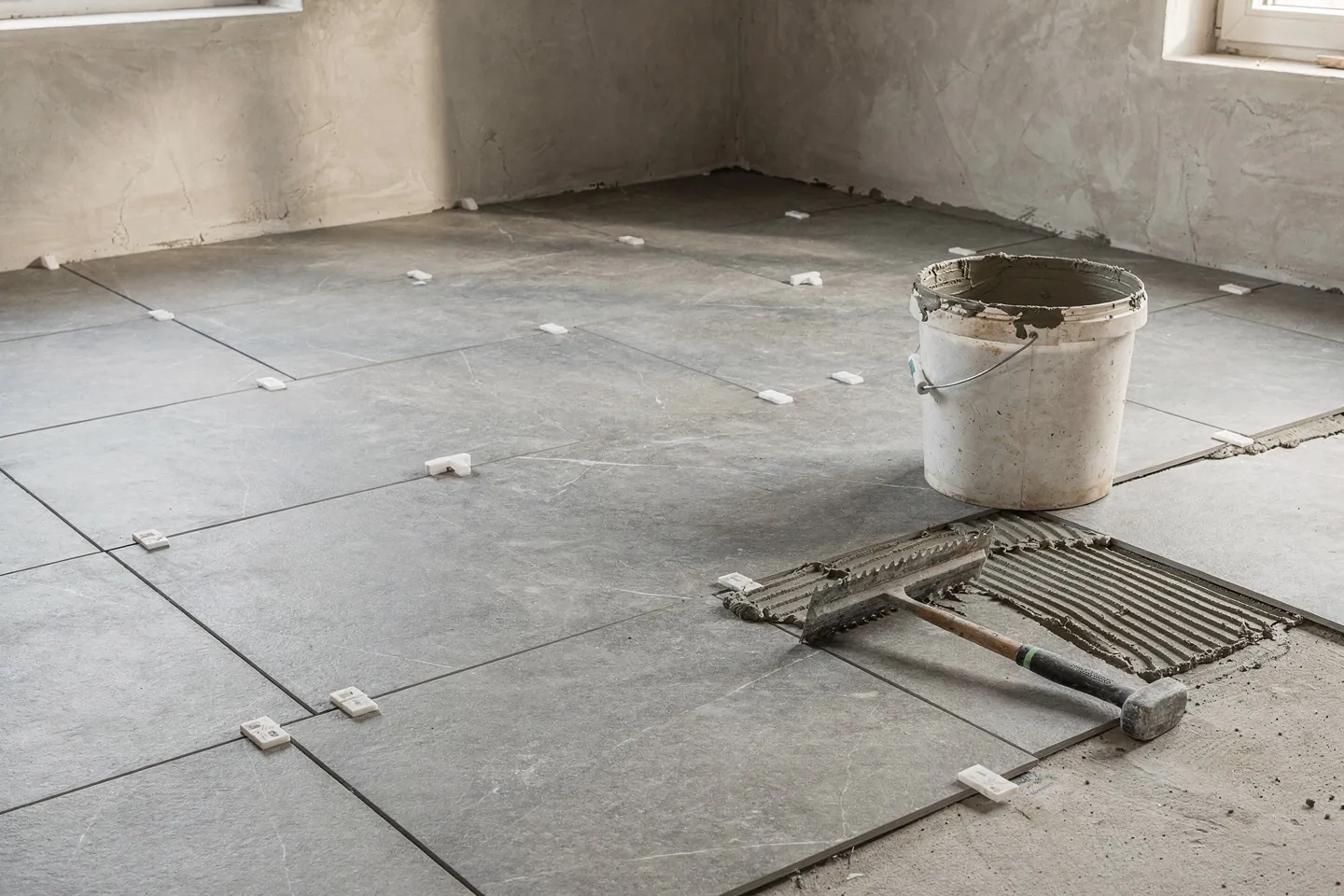
A tile levelling system with clips and wedges keeps the faces level while laying. The tile maker advises placing the manufacturer-recommended pads under the wedges so the edges do not chip.
Which tile adhesive: what do C1, C2, T, E and S1 mean?
Tile adhesives are classified by STN EN 12004-1 of January 2020, the adoption of EN 12004-1:2017. It gives no criteria for the design and installation of tiles. A code on the bag, for example C2TES1, reads as follows:
| Code | Meaning per TTA | Example from a technical sheet or TTA |
|---|---|---|
| C | cement-based adhesive | all adhesives in this article |
| D | dispersion adhesive | ready-mixed paste in a tub |
| R | reaction resin adhesive | some agglomerated tiles |
| 1 | normal adhesive | small-format sheet (text: C1T): edge up to 30 cm, area up to 0.1 m², indoors |
| 2 | improved adhesive, usually with higher bond strength | C2TE S1: up to 1.5 m² and 150 cm edge, also underfloor heating |
| F | fast-setting adhesive | add-on for large formats |
| T | adhesive with reduced slip | slip at most 0.5 mm under STN EN 12004 |
| E | adhesive with extended open time | bond strength at least 0.5 N/mm² after 30 minutes |
| S1 | deformable adhesive | transverse deformation from 2.5 mm to less than 5.0 mm |
| S2 | highly deformable adhesive | transverse deformation over 5 mm, also OSB boards at least 25 mm thick |
When does deformability matter? With underfloor heating, large formats and board substrates. For underfloor heating TTA recommends at least a C2 adhesive and a CG2 grout. For large formats it asks for class 2 with F, T, E, S1 or S2 added where applicable. For board substrates such as OSB or plasterboard, the adhesive maker gives indicative thicknesses of 20 to 25 mm for horizontal structures.
Cement or epoxy grout?
Tile grouts are classified by the EN 13888 series. Per TTA, CG1 is a normal and CG2 an improved cementitious grout, RG a reaction resin grout. The add-on A means improved abrasion resistance, W improved water resistance. A flexible CG2 WA cement grout is, by its technical sheet, intended for joints up to 8 mm, including porcelain and heated floors. The sheet excludes places that need watertightness and chemical resistance, and movement joints and corners. For wider joints and chemical loads the maker's adhesive sheet names other grouts, and the Czech tile maker recommends epoxy grout where chemical resistance is needed. Epoxy grout RG, however, does not replace the waterproofing under the tiles: TTA asks for a waterproof background in showers.
Where do movement joints have to go?
A movement joint with a flexible filling takes up the movement of tiles, adhesive and screed before the tiles crack or debond. The sources agree on a perimeter joint, carrying structural joints through and smaller bays over heating, but differ in the numbers:
- TTA, United Kingdom: perimeter and intermediate floor joints at least 6 mm, intermediate joints in larger areas at 8 to 10 m intervals. Over underfloor heating, bays of at most 40 m² with edges up to 8 m.
- Czech catalogue, after ČSN 74 4505 and ČSN 73 3451: perimeter joint 5 mm, indoor bays with edges of at most 6 m, outdoors and over underfloor heating 3 m, side ratio at most 1 : 1.5.
A PE backing cord goes into the joint, which is then filled with sanitary silicone. The cord, the Czech maker says, stops the sealant from bonding on three sides and tearing.
Slip-resistant tiles: what do R10 and groups A, B, C mean?
Slip resistance appears in catalogues on two German scales from an inclined-ramp test. Classes R9 to R13 are for shod feet, groups A, B and C for wet barefoot areas. A German tile maker's guide of October 2025 finds the shod angle under DIN EN 16165, Annex B. It says DIN 51130 now covers only the displacement space below the walking surface (rating V). In Slovakia, STN EN 16165 of January 2022 applies. The German accident insurance's test laboratory (IFA) says EN 16165 replaced DIN 51097 and DIN 51130 (Annexes A and B). The 2025 Czech catalogue still lists DIN 51097, which the DIN catalogue shows as withdrawn.
| Class | Ramp angle | Examples of areas from German rules |
|---|---|---|
| R9 | over 6° to 10° | indoor entrances and stairs, toilets at workplaces |
| R10 | over 10° to 19° | changing and washrooms at workplaces |
| R11 | over 19° to 27° | outdoor entrances and outdoor stairs, or R10 V4 |
| A | over 12° to 18° | barefoot corridors, largely dry sanitary areas, changing rooms |
| B | over 18° to 24° | showers, pool surrounds |
| C | over 24° | stairs and ladders into water, sloping pool edges |
These tables are written for workplaces and public pools. The Slovak decree 532/2002 Z. z., which under § 84(23) of building act 25/2025 Z. z. stays in force until 31 March 2027 at the latest, requires an anti-slip finish with a friction coefficient under STN in public buildings. It requires a watertight anti-slip floor on balconies and loggias (§ 32(3) and (4)). Otherwise it only requires in general terms that falls through badly designed slipperiness be avoided (§ 19(2)). It leaves the friction coefficient of ramps and of outdoor stair treads to the STN standards (§ 27(7)). The decree sets no R class and no A, B or C group for a family house.
The architect borrows a yardstick: for a shower and bathroom walked on barefoot, the usual choice is a declared barefoot group. For a terrace, the figure for outdoor entrances, R11 or R10 V4, is a reasonable guide. Watch out for smooth rectified porcelain: the January 2026 sheet mentioned above gives it R9 and "not classified" for barefoot use.
How is the waterproofing under tiles handled in a wet zone?
In showers and wet rooms TTA asks for tiling onto a waterproof background with at least a C2 adhesive, a solid bed without voids and taped corners. The adhesive maker recommends liquid-applied waterproofing with sealing tapes for indoor surfaces, and warns that on a waterproofed substrate the adhesive takes considerably longer to cure. Fall, drain and the choice of coating are covered in the article Tray-free shower: fall and waterproofing.
What to ask the tiler before work starts?
The Czech tile maker names poor adhesive coverage as one of the most common hidden defects in tiling. Before work starts, agree on:
- Which adhesive, and whether its EN 12004 class matches the format and the substrate.
- How the substrate flatness is checked and what will correct unevenness.
- How back coverage is achieved on a large format.
- Where the movement joints go.
- What screed moisture was measured, compared with the adhesive sheet.