Must you connect to the public sewer if the village has one?
Yes, unless you hold a permit for another way. The owner of a building or plot where wastewater arises must connect to the public sewer. The owner must also sign a connection contract with the sewer owner. This applies where the municipality has a public sewer. It does not apply if the owner holds a state water authority permit for another way of handling wastewater (Act 442/2002, § 23(2)). The article A Plot Without Utility Connections explains how to arrange a sewer connection.
Government Regulation 269/2010 covers small plants for up to 50 population equivalents. Such a plant is built when a sewer connection is not technically possible and would cost unreasonably much (§ 5a(1)). Where a sewer already exists, a small plant is allowed only if connecting is technically or economically unreasonably expensive (§ 5a(4)).
When does the law allow a holding tank or a domestic plant?
The Water Act allows individual systems, mainly watertight holding tanks and small wastewater treatment plants. In agglomerations above 2,000 population equivalents, you may use them only where a public sewer brings no environmental benefit or costs unreasonably much. Smaller agglomerations without a sewer may use mainly holding tanks. Sparsely populated areas may use small plants too (Act 364/2004, § 36(2) and (3)).
A permit to build an individual system has a fixed term. If a public sewer is built and put into service in the area, the authority does not extend the permit after it expires (§ 36(4)). The owner of a plot with a permitted holding tank must connect to the sewer. This applies if connecting is technically possible and does not need unreasonably high costs (Act 442/2002, § 23(2)).
What must a holding tank meet and what does the municipality want?
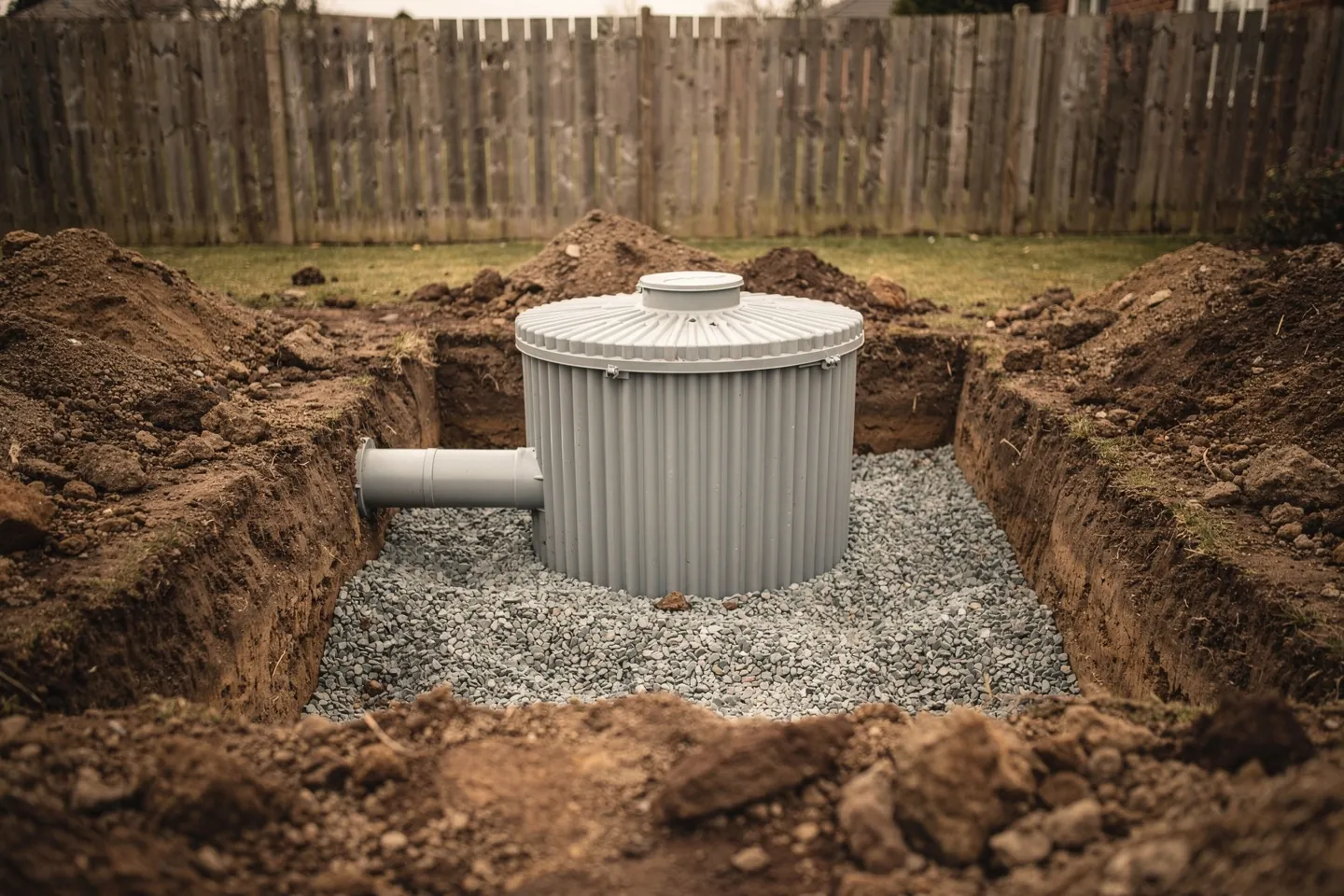
A holding tank does not treat wastewater. It only stores it. The act therefore speaks of watertight holding tanks, and their content must go to a wastewater treatment plant (Act 364/2004, § 36(2) and (3)). When the municipality or the state water authority asks, the owner shows receipts for at most the last two years (§ 36(4)).
Only the public sewer operator, the municipality or an authorised person may haul the wastewater. The receipt must state your name and address, the date, the location of the tank and the volume removed. It must also state the name of the haulier and the address of the treatment plant (§ 36(4)). Discharging the content of holding tanks into surface water or groundwater is prohibited (§ 36(15)).
Building Act 25/2025 lists holding tanks as minor structures. The structure must be underground, with a built-up area up to 25 m2 and a depth up to 3 m (§ 2(4)(b)). You notify such a structure to the building authority (§ 18(3)). The municipality issues a statement on domestic holding tanks (Act 364/2004, § 63(3)(a)). From 1 January 2027, amending Act 243/2026 changes both § 2 and § 18 of the Building Act. Check the procedure again before you file.
Septic tank, holding tank and treatment plant: what is the difference?
The Water Act separates primary and secondary treatment. Primary treatment is a physical or chemical process, such as settlement. It cuts BOD5 by at least 20 % and suspended solids by at least 50 %. Secondary treatment uses biological processes with gravity separation of sludge, or another way that meets the required limits (Act 364/2004, § 2(p) and (q)). According to a Ministry of Environment paper, every small treatment plant must provide at least secondary treatment.
The Water Act, the Sewerage Act and Regulation 269/2010 do not name septic tanks. A septic tank falls under EN 12566-1 (prefabricated septic tanks), a treatment plant under EN 12566-3. A septic tank declaration from Wavin-Labko (2015) gives hydraulic efficiency as grams of beads. A plant declaration from KLARO (2018) gives the percentage of pollution removed. Ask the water authority how it classes a septic tank.
| Unit | Rule or standard | How the maker shows performance | What happens to the content or outflow |
|---|---|---|---|
| Watertight holding tank | Minor structure up to 25 m2 and 3 m (Act 25/2025, § 2(4)(b)) | No treatment, it only stores water | Haulage to a plant, receipts for two years (§ 36(4)) |
| Septic tank | EN 12566-1, prefabricated septic tanks | Hydraulic efficiency, for example 0.8 g of beads | Discharging wastewater needs a permit (§ 21(1)(c)) |
| Domestic treatment plant | EN 12566-3, a water structure (§ 52(1)(e)) | Removal percentage, for example BOD5 98.1 % | Permit to surface water for up to 10 years, to groundwater up to 6 years (§ 21(4)) |
How does a domestic plant work and how is it sized?
A domestic treatment plant treats the sewage of the house, including the blackwater from the WC (see blackwater treatment). The Water Act defines a small plant as a set of structures and equipment. It serves up to 50 population equivalents with an inflow below 10 m3 a day (§ 36(18)). Regulation 269/2010 separates two types. Intensive plants follow the declaration of performance rules of Regulation (EU) 305/2011. Extensive plants are built on site with upstream pretreatment and a horizontal or vertical filter (§ 5a(2)).
Size is given in population equivalents (PE). One PE equals a load of 60 g BOD5 a day (Act 364/2004, § 2(s)). The KLARO One range for 5 to 50 inhabitants (declaration of 8 August 2018) is one example. It allows at most 150 litres and 0.06 kg BOD5 per inhabitant per day. It declares 98.1 % removal of BOD5 and 98.5 % of ammonium nitrogen.
STN EN 12566-3 adopts EN 12566-3:2016. According to the DIN summary, it covers plants buried in the ground with no vehicle loads. One manufacturer assembles and tests each plant as a whole. If the tank is to sit under a driveway, ask the maker what its declaration covers.
Regulation 269/2010 sorts small plants into categories. Category I meets the state water authority's minimum requirements for most locations. Higher categories meet stricter ones (Annex 14b, part A.1).
| Category | What the system does | Where it applies | Min. BOD5 removal for discharge to surface water |
|---|---|---|---|
| I | Removes organic pollution | Most locations | 80 % |
| II | Nitrification | Where ammonium nitrogen must be limited | 85 % |
| III | Nitrification and denitrification | For example protected water management areas | 85 % |
| +P | Also removes phosphorus | Areas at risk of eutrophication | 85 % |
Category +D adds disinfection, for example in drinking-water source protection zones and near bathing waters. For discharge to groundwater, CE-marked products must remove at least 85 % of COD and 90 % of BOD5. They must also remove 50 % of total nitrogen and 40 % of total phosphorus (Annex 14b, parts A.2.1 and A.2.2). Annex 6 also sets concentration limits. For BOD5 (ATM), the limit for surface water is 70 mg/l in category I and 50 mg/l in II. It is 40 mg/l in III, +P and +D. For groundwater it is 40 mg/l in all categories (Annex 6, parts A.1.1 and A.2). The permit sets the allowed values for your site (Act 364/2004, § 21(2)(d)).
Where does the treated water go: a stream or a soakaway?
The regulation prefers surface water. A small plant discharges there first, and the owner must be able to take a sample for checks. If the water has to go to groundwater, a soakage structure is also required (269/2010, § 5a(7)). Both routes need a permit for special use of water (Act 364/2004, § 21(1)(c)).
A soakaway depends on the ground. The authority grants a permit to discharge to groundwater only after a prior investigation by an authorised person. The investigation assesses the hydrogeology, the self-cleaning capacity of the soil and rock, and the risk of groundwater pollution. The applicant pays for it (§ 37(1) and (2)). An isolated dwelling that cannot be connected to a sewer does not need it if it lies outside drinking-water source protection zones (§ 37(5)). The geotechnical survey for the foundations shows the soil too.
Checks are regular. For a source up to 50 PE, at least one sample a year is taken for discharge to surface water. At least two samples a year are taken for discharge to groundwater (269/2010, Annex 7, tables 1 and 2).
Which permits do you need and who issues them?
A wastewater treatment plant is a water structure (Act 364/2004, § 52(1)(e)). For water structures, the state water authority is the special building authority. If the plant is part of a set of structures with the house, the building authority for the house decides on the building intent. The state water authority then acts as an affected authority (§ 26(3)). The discharge permit must be issued before the building intent decision or together with it in a joint procedure (§ 21(2)). It lasts at most 10 years for surface water and at most 6 years for groundwater. The authority may extend it if the conditions do not change (§ 21(4) and (5)).
- Before buying: ask the municipality whether a sewer exists or is planned.
- During design: holding tank or plant, and for a plant, stream or soakaway.
- During permitting: notify a holding tank, apply for a discharge permit for a plant.
- At completion: you use a water structure on the strength of an occupancy certificate (§ 26(4)).
For rainwater, see Rainwater: Retention and Harvesting.
What does day-to-day operation involve?
The owner operates the plant under the authority's decision, the operating rules and the maker's recommendations. Operation covers regular checks, maintenance, regular sludge removal and a record of removals by an authorised person. It also covers remote monitoring of function (269/2010, § 5a(10) and (14)).
The owner of a small plant must have an inspection technician do a technical inspection. It takes place once a year, or once every two years with remote monitoring. The results go to the state water authority by 30 January of the following year. The owner must fix defects within 60 days (Act 364/2004, § 53(2)). According to the ministry, the law sets no maintenance intervals. This page gives no prices, because it has no dated official source for them.
What are the most common mistakes?
- Plant outflow into the public sewer. If the sewer has a plant with permitted treatment, do not discharge holding-tank content or domestic plant water into it (Act 442/2002, § 23(7)).
- A plant without a declaration of performance. For an intensive plant, you must supply it (269/2010, Annex 14b, part A.1).
- A soakaway without knowing the ground. Outside the exception in § 37(5), the prior investigation is a condition of the permit.