How do you tell Gothic from Romanesque?
Gothic started in France with the rebuilding of the abbey church of Saint-Denis under Abbot Suger. The ambulatory and choir date from 1140–1144. A college art-history textbook (Palomar College) names three features that set Gothic apart from Romanesque. The pointed arch lowers the sideways thrust, so slimmer columns and piers are enough. The ribbed vault is one of the typical signs of the style. The flying buttress made room for more windows, and stained glass filled them.
The same textbook says Romanesque churches had massive drum-like columns. It also notes that prototypes of pointed arches and ribbed vaults already appear in late Romanesque buildings. So one sign is not enough. An overview by the Ústav územního rozvoje (ÚÚR) in Brno, a Czech state institute, adds more signs. A Gothic buttress differs from a Romanesque one by its stepping, which follows the structural load, and pinnacles weigh it down from above. Large church windows end in a pointed arch, stone mullions divide them, and tracery fills the top. A rose window appears on the west side of cathedrals. According to ÚÚR, the portals of large churches differ from Romanesque ones only in the pointed arch and the style of figural carving.
On a site visit, look for several signs together and check them in a heritage survey.
| Feature | What the sources say about Gothic | Dating trap |
|---|---|---|
| Arch | Arches are mostly pointed because this is structurally better (ÚÚR) | ÚÚR also lists round and segmental arches in Gothic. The late Gothic ogee arch is only decoration |
| Vault ribs | Ribs split the vault into a load-bearing part and an infill and make it lighter (ÚÚR) | The Monuments Board of the Slovak Republic shows a rib vault in the Romanesque charnel house at the Old Castle in Banská Štiavnica |
| Windows | Large windows with pointed heads, stone mullions and tracery (ÚÚR) | ÚÚR notes that secular buildings have rectangular windows |
| Buttresses | Stepped buttresses, flying buttresses and pinnacles form the buttressing system (ÚÚR) | In Košice, Medieval Heritage says buttresses of the older Romanesque church already suggest a vault |
| Portal | Pointed arch and figural carving (ÚÚR) | A walled-up Gothic portal is often hidden under a later facade (Monuments Board of the Slovak Republic) |
How did Gothic vaults change: cross, star, net?
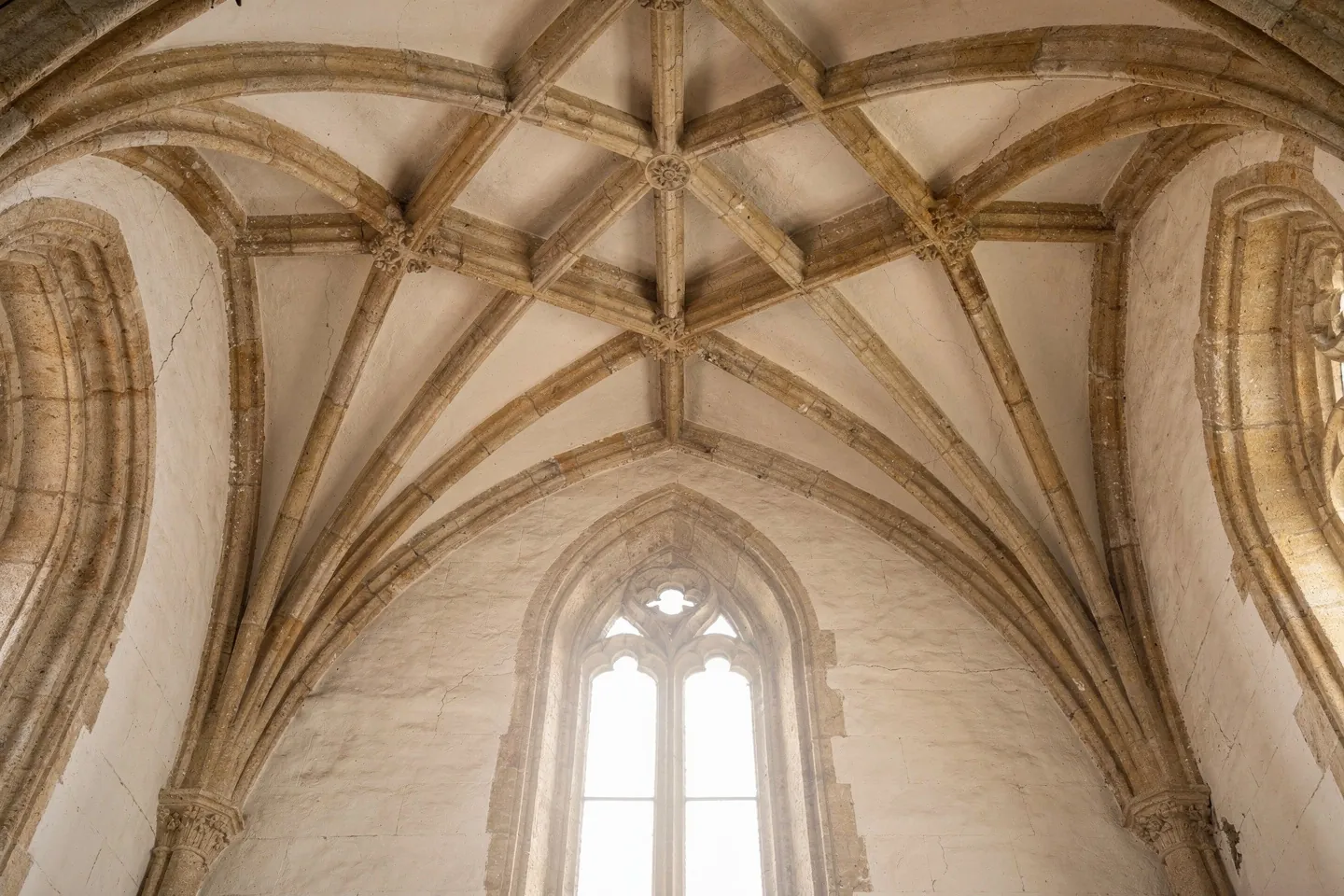
The Monuments Board's methodology on ceilings classifies vaults by shape. A cross vault forms where two barrel vaults intersect. Stone ribs can mark the lines of its edges, and the star vault is a special kind of cross vault. The same document says that the structural type, material and shape of a vault are characteristic of a style. Masons built vaults of stone or brick on timber centring. They removed the centring only after the mortar set.
ÚÚR describes the sequence of types using Czech Gothic. Buildings of the transitional period had cross vaults, and early Gothic used the six-sided vault. In a net vault, the diagonal ribs do not run from one side to the opposite side: another rib catches them. According to ÚÚR, Peter Parler first built it at St Vitus Cathedral in Prague in the second half of the 14th century. It became typical of high and late Gothic. The looped vault appeared in Austria in the middle of the 15th century and, says the same source, was not a technical advance but decoration.
| Vault type | How to recognise it | Example in Slovakia from the sources |
|---|---|---|
| Cross-rib | Two barrel vaults intersect, ribs mark the edges | Nave and aisles of St James in Levoča. The nave of the cathedral in Spišská Kapitula |
| Star | A special kind of cross vault, the ribs draw a star | Aisles of the cathedral in Spišská Kapitula. The 15th-century south porch in Levoča |
| Net | The ribs catch one another and form a net | North porch in Levoča, first quarter of the 16th century. The Zápoľský Chapel in Spišská Kapitula |
| Star-net | Star and net patterns combined in one vault | The chancels of Košice and of St Martin's in Bratislava |
| Looped | Curved ribs, mainly decorative | Church of Our Lady of the Snows in Banská Štiavnica |
Beware of restorations. In Košice the aisles originally had star vaults, and the renovation of 1877–1896 changed them to net vaults, according to the City of Košice. A vault in a church may not be the one the medieval masters built.
When you look up, also notice the bosses, the stones where the ribs meet. Medieval Heritage counts 23 in St Martin's Cathedral, carrying the arms of towns, families and regions linked to the building, including Matthias Corvinus.
Where can you see Gothic churches in Slovakia?
The table lists five buildings with open sources on Gothic features and dates. The sources sometimes disagree. For Košice, the City of Košice puts the start of the Gothic building at about 1378. The tourism portal slovakia.travel gives 1380 and the Medieval Heritage website about 1390. Treat the date as approximate.
| Building | Gothic building work per the source | What to look for |
|---|---|---|
| St Elisabeth Cathedral, Košice | From about 1378, chancel finished 1508 (City of Košice) | Polygonal chancel, stepped buttresses with pinnacles, north portal with the Last Judgement |
| St Martin's Cathedral, Bratislava | From about 1300, consecration 1452, new chancel about 1487 | Aisled hall church, 23 bosses, star-net vault over the chancel |
| St James Church, Levoča | Rebuilding under Charles Robert (1307–1342), late Gothic phase 1446–1460 | South portal of about 1380 with tracery in the tympanum, Master Paul altar of 1508–1510, about 18.6 m high |
| Basilica of St Egidius, Bardejov | From the early 15th century, main nave finished 1513–1518 | Three-aisled basilica, 11 late Gothic winged altars from 1460–1520 |
| St Martin's Cathedral, Spišská Kapitula | Gothic rebuilding of a Romanesque church 1462–1478 | New elongated chancel, the Zápoľský Chapel of 1493–1499 with a net rib vault |
Spišská Kapitula shows the change of style best. According to the cathedral's website, the rebuilding of 1462–1478 added a new chancel to the east. It raised the nave and gave it a cross vault. It also turned the original chapels and transept into aisles with star vaults. The church thus became a hall church. The UNESCO World Heritage Committee listed the site in December 1993, says the Ministry of Culture. In 2009 it extended the listing in Seville to Levoča and the work of Master Paul (decision 33 COM 8B.36).
Slovakia.travel calls the Košice cathedral the largest church in Slovakia and the easternmost Gothic cathedral of western type in Europe. According to the same source, its main altar of 1474–1477 holds 48 Gothic panel paintings.
How do you recognise a Gothic town house?
Gothic is not only churches. The Monuments Board's methodology on burgher architecture says that archaeologists on Kováčska Street in Košice found the foundations of two single-room hall houses. Each had a projecting outdoor staircase. These are among the basic types of Gothic stone or brick town houses in Slovakia. They had two storeys, the lower one partly sunk into the ground, and their fronts stood about 5–6 metres behind the street line. The methodology says that fortified towns had a fixed number of plots with late Gothic stone houses. Only a small share of them had an upper floor in the last third of the 15th century.
In Bratislava, the methodology divides tower houses into two groups. The Romanesque ones date from the late 12th to the first half of the 13th century. The later Gothic ones date from the end of the 13th century. The Himmelreich house at Františkánske námestie 9 is early Gothic. Builders made such houses of rubble stone and reinforced the corners with dressed stone blocks.
The methodology calls the house with a carriage passage to the courtyard the most common type of town house in urban heritage reserves and zones. Builders made it from the 13th century. The methodology says that passages were often widened on purpose in the Gothic and Renaissance periods, for example in Prešov, Levoča and Bardejov. Sedilia, set off with moulded stone elements and painting, became a typical feature of these passages. On a site visit it is worth looking into the passage and the cellar, not only at the facade. According to ÚÚR, secular buildings often had rectangular windows, so a house without pointed windows can still have a Gothic core.
Why does neo-Gothic mislead dating?
The neo-Gothic of the 19th century copied Gothic forms so closely that it confuses even an experienced visitor at first glance. The cathedrals in Košice, Bratislava and Spišská Kapitula and the church in Levoča all went through neo-Gothic or historicising work in the 19th century. In Bratislava, after a fire in 1833, the tower and front were rebuilt in 1835–1846. In Levoča, a neo-Gothic tower, built from 1841 to 1858, replaced the demolished Gothic one. The Košice cathedral went through a renovation in 1877–1896. It changed two aisles into four and demolished the late Gothic chapel of St Joseph. It also, says Medieval Heritage, "extremely re-Gothicised" the building. The City of Košice also lists the change of the aisle star vaults to net vaults.
The furnishings are no proof either. Of the 13 Gothic winged altars of Spišská Kapitula, five survive according to the cathedral's website. Slovakia.travel notes that the reconstruction of 1873–1889 removed Baroque features so that the cathedral regained a medieval look in the taste of Romanticism. A detail that looks medieval can therefore be centuries younger. How 19th-century historicism turned into the next style is the subject of Secession in Slovakia.
What should the owner of a house with Gothic features know?
Protection depends on legal status, not on style. Act No. 49/2002 on the protection of the monument fund defines a cultural monument as a thing of monument value declared a monument (§ 2 ods. 3). The Monuments Board of the Slovak Republic keeps the central list (§ 22 ods. 1). The owner of a monument carries out its basic protection at their own cost (§ 28 ods. 2) and, before a restoration, asks the regional monuments office for a decision on the restoration intent (§ 32 ods. 2). If the house is not a monument but stands in a monument area, the owner must first obtain a decision on the intended alteration (§ 32 ods. 5). What a heritage protection zone means, and the full renovation procedure step by step, are the subject of Renovating a house in a heritage zone.
For town houses, the Monuments Board's methodology asks owners to keep niches, aedicules, sedilia and lavabos, and the typical splayed reveals of windows and doors. For vaults, it requires thorough diagnosis and removal of the cause of damage. A structural engineer must carry out the full diagnosis of a load-bearing ceiling. A restoration should keep interventions into the fabric of a vault to a minimum and, where possible, use traditional materials and methods.