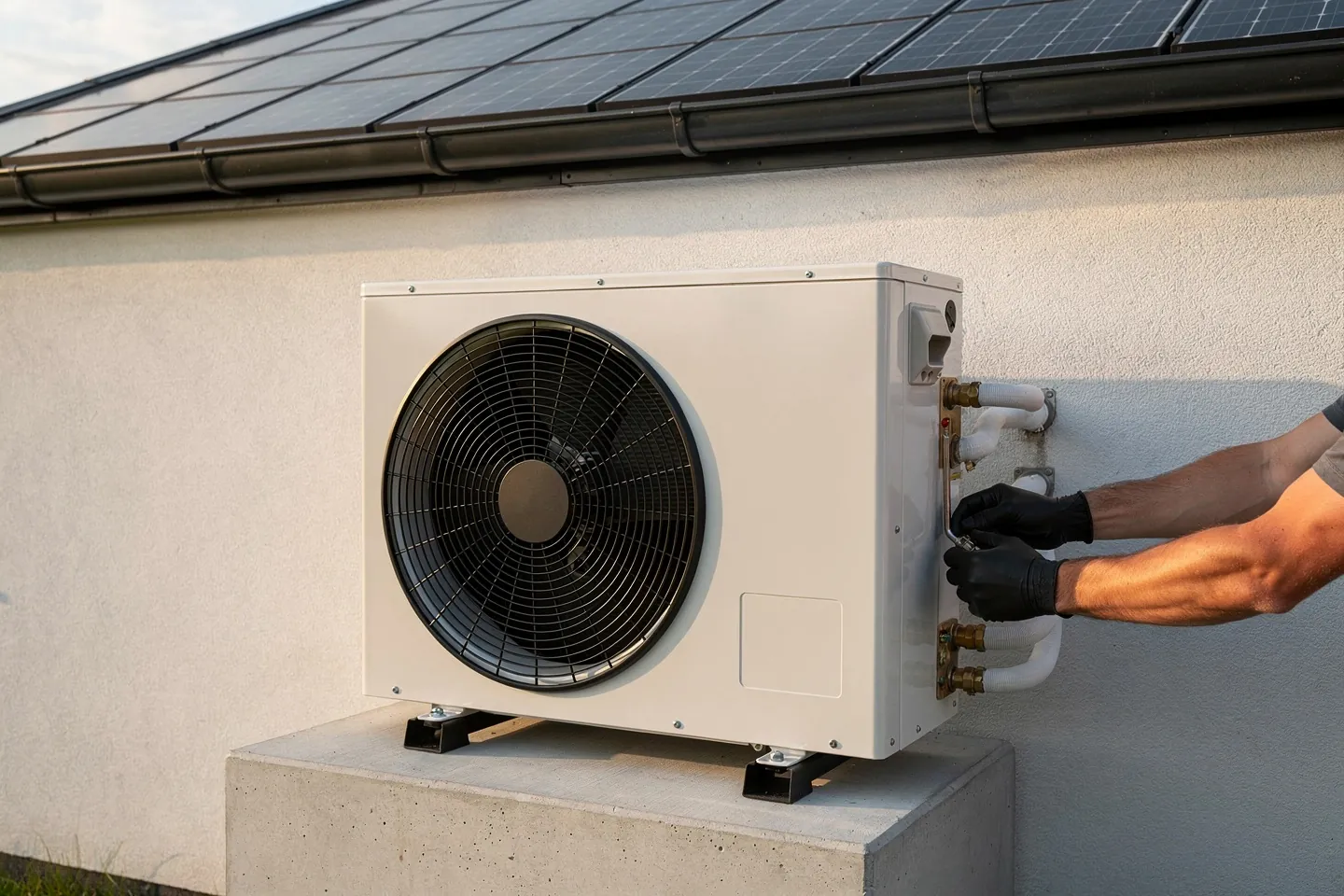
What is Zelená domácnostiam II and what changed in autumn 2026?
Zelená domácnostiam ("Green for Households") is a national project run by SIEA, the Slovak Innovation and Energy Agency. It contributes to small devices producing electricity or heat from renewable sources in family houses. The general conditions of Zelená domácnostiam II, version 1, apply from 21 October 2026. The indicative allocation for contributions is 28.6 million euros, of which 1.6 million is for the Bratislava region and 27 million for the other regions.
The biggest change is who receives the money, and when. The voucher system, in which the installer deducted the voucher value from the price and SIEA then reimbursed the installer, ends in Zelená domácnostiam. Now the household pays the full installation price and SIEA sends the contribution to the household's account after checking the documents. The household chooses its own supplier and files the application itself. Registrations from the old system do not carry over.
The schedule on the programme site lists three phases: publication of the conditions on 21 September 2026, opening of application registration on 26 October 2026, and reservation requests from 2 November 2026. Eligible devices are those commissioned after 1 January 2024 with expenses after that date. Contributions are paid until the money runs out, and no later than 31 December 2029.
What does the procedure look like, step by step?
SIEA describes ten steps, and the conditions condense them into three actions in the form: registration, reservation of funds and the complete application. The table shows the whole procedure.
| Step | Who | What, and the deadline |
|---|---|---|
| 1. Choose the device | Household | Reads the conditions and picks a type from the list of eligible devices. The specific type must be on the list. |
| 2. Agree with a supplier | Household and supplier | Agree on the device, the price and the date, ideally in a written contract. |
| 3. Register the application | Household | Fills in the form on zelenadomacnostiam.sk, open since 26 October 2026. Registration does not set the order. |
| 4. Request a reservation | Household | Possible from 2 November 2026. The exact time of the request sets the place in the queue. |
| 5. Reservation confirmed | SIEA | Confirms by e-mail once the reserved volume falls below 1,000,000 euros, and reserves up to at most 2,000,000 euros. |
| 6. Installation and payment | Supplier and household | Installation, commissioning, payment of the full invoice and photographs. |
| 7. Complete application | Household | Submits it with the attachments within 45 calendar days, counted from the day after the reservation. The deadline cannot be extended. |
| 8. Assessment | SIEA | Within 60 working days. If something is missing, it sends a request for completion with a deadline of at least 7 working days. |
| 9. Contract | SIEA and household | SIEA sends it within 30 calendar days of the notice that the conditions are met. The household returns it signed within 30 days. |
| 10. Payment | SIEA | Publishes the contract in the Central Register of Contracts. Under the model contract it pays within 30 calendar days of the contract taking effect. |
| 11. Operation | Household | Keeps the device in operation for at least 5 years from the contract taking effect. |
A household whose device is already installed can submit the complete application straight after requesting the reservation. SIEA assesses it only once the application has a reservation. Contributions are paid until the allocation is used up, so without a reservation you receive none.
How do you register on zelenadomacnostiam.sk?
The property owner registers through the electronic form on the programme site. According to SIEA, entering the basic data usually takes no more than 5 minutes. After registering, the household receives login details by e-mail for an account in which it can correct most data. The cadastral area, district, municipality, device type and registered e-mail cannot be changed. A mistake in any of them means filing a new application and cancelling the original one.
You can authorise the installer, but only with an officially certified power of attorney attached to the application. In a dispute with the firm you would have to visit SIEA in person.
How does the reservation work and how long is it valid?
A reservation request places the application in the queue. The order is set by the time the information system recorded it, but a place in the queue is not yet a reservation. SIEA confirms reservations in stages, when the total reserved volume falls below the minimum limit, and adds more up to the maximum limit.
The reserved amount is the maximum possible contribution for that device type. SIEA sets the actual amount only from the complete application, by device output and eligible expenses, under the conditions in force when the reservation was confirmed.
From confirmation, a period of 45 calendar days runs. It starts the day after the reservation and cannot be extended. By its end the device must be installed and paid for and the complete application submitted. If you miss it, the reservation is cancelled and you have to request a reservation again. That is why it pays to have the supplier and the date agreed before the confirmation e-mail arrives.
There is no voucher in Zelená domácnostiam II, so no voucher validity either. It remains in the sister project Zelená solidarita for low-income households, where the installer submits documents within 90 days of its issue.
Which technologies are covered and what should you check before choosing?
Five device types are supported, and the specific product type must be on the list of eligible devices. The amounts come from the conditions read on 13 November 2026. The contribution is also capped at 50 % of eligible expenses.
| Device | Maximum contribution (with the bonus) | What to check before choosing |
|---|---|---|
| Photovoltaic panels | 1,000 euros (1,150 euros), on 2 kW of output | The system can be larger, but the contribution counts only 2 kW. The inverter must be on the inverter list. Panels must not stand on agricultural land. Grid connection follows the distribution company's conditions. |
| Solar collectors | 2,000 euros (2,300 euros), on 4 kW of output | Hot water or heating support. Output shown by a Solar Keymark test report, manufacturer's stated life of at least 20 years. |
| Heat pumps, for example air-to-water | 4,000 euros (4,600 euros), on 10 kW of output | Water-based systems: class A++ in the EPREL database at 35 °C. Air-to-air: class A+ in heating mode, and only in a house without a hot-water heating system. Life of at least 10 years. |
| Biomass boilers (pellets) | 1,800 euros (no bonus), on 15 kW of output | Must replace an appliance burning solid fossil fuel, shown by photographs of the old appliance connected and then removed. Class A+ in the EPREL database. |
| Wind turbines | 1,000 euros (1,150 euros), on 2 kW of output | The devices page flags environmental impact assessment and the distribution company's conditions. Life of at least 15 years. |
The 15 % bonus goes to a household that installs an emission-free device in an air quality management area, or that stops using solid fuels. According to SIEA, these areas are marked with risk level 3 in the list. SIEA does not count a biomass boiler as emission-free.
For photovoltaics it makes sense to size the array to your own needs rather than to the subsidy, since the contribution covers only 2 kW anyway. What decides the payback is self-consumption of the electricity produced. A battery is not a separately supported device type. If it is part of the installation, the conditions ask for its technical data sheet, and the model contract requires proof to SIEA of its disposal if it reaches the end of its life while the contract is in force.
How do you find an installer, and must it be registered?
In Zelená domácnostiam II the choice of supplier is free. You may use the list of installers on the project site, but you do not have to. It remains mandatory only for Zelená solidarita, where only a registered installer may do the work. Free choice does not mean anyone can fit the device. SIEA writes that the household is responsible for the choice and should check that the firm is professionally competent and authorised to install that type of device.
SIEA no longer binds firms by contract, so you need to agree the terms yourself. The written contract should state the exact device and inverter type, the output, the price, a date that fits the 45-day period and the handover of documents.
What does the household pay and how much does it get back?
The household pays the supplier the full price of supply and installation, including any advance payments. The contribution is a refund. SIEA pays the lower of two amounts: the rate times the supported output, or 50 % of total eligible expenses, rounded down to whole euros. Eligible expenses are the purchase price of the device as a working whole.
An example from the rates: an 8 kW heat pump is entitled to at most 3,200 euros at the basic rate. If half of the eligible expenses is lower, that half is paid.
The invoice must be made out to one of the owners, with a delivery date after 1 January 2024 and the exact product type and number of units. A repayment schedule or a loan agreement is not enough as proof of payment. With a loan, you need the bank's confirmation of payment directly to the supplier. The contribution goes only to an owner's current account, not to a business, loan or savings account.
What happens after installation?
The household completes the form and attaches the mandatory documents: a copy of the invoice, proof of payment of the full price, a declaration of eligibility, proof of account ownership and photographs. The photographs must show the whole device, the house and a legible rating plate, and for photovoltaics also the inverter's plate.
SIEA checks the type, the number of units and the expenses, and may inspect on site. If even a repeated request for completion does not fix the gaps, it ends the assessment and cancels the reservation. With a positive result, it sends the contract. A paper contract must be returned with an officially certified signature, an electronic one with a qualified electronic signature. The contract takes effect the day after publication in the Central Register of Contracts, and only then does the entitlement to the contribution arise.
Five-year obligations then apply: keep the device in operation and do not use it for business. The house must not pass to a legal person, and a sale to a natural person needs SIEA's prior consent.
How does Zelená domácnostiam differ from Obnov dom?
These are two separate programmes. Obnov dom mini+ is aimed at households at risk of energy poverty and contributes to a combination of measures, from insulation and new windows to a heat source, up to 11,000 euros. Zelená domácnostiam has no income condition and contributes to a device, once per device type. The rules, eligibility and procedure of Obnov dom are covered in the Obnov dom mini+ subsidy guide.
Both programmes can be used in one house, but not for the same device. SIEA rejects an application if, at the same address, it already records the same device type supported from another public source, including Obnov dom. With insulation and a heat pump, decide in advance which programme pays for what.