Why the worktop decision comes earlier than you think
The worktop is the hardest-working surface in the whole house. People cut on it, put hot pans on it, spill water, wine and oil on it, and it is on show all the time. Even so, many people choose it last, once the kitchen is drawn and the fronts are picked. That is the wrong order. The worktop material decides its thickness, the longest length without a joint, how the sink and hob are fitted, and which splashback suits it.
The position of the sink and hob, set by the work triangle, also decides where the cut-outs and joints will fall. In this article I compare common worktop materials, the splashback behind the kitchen and the small things that are easy to miss in a project. I deliberately give no prices: they vary so much with the manufacturer, thickness, number of cut-outs and transport that any figure would mislead. When a whole bespoke kitchen is worth it is covered in Built-in furniture: when it pays off.
Which worktop materials are worth considering?
Laminate
A laminate worktop is a chipboard or fibreboard core with a thin decorative layer on the surface. It is the most affordable option, light, and can be worked directly on site. Its weak point is water: wherever the surface is broken, for example at the sink cut-out or at a badly sealed joint, the core absorbs moisture and swells. That damage cannot be repaired; the worktop has to be replaced. A hot pan placed directly on the surface leaves a mark.
Solid wood
Solid wood, most often oak or beech in glued staves, is warm to the touch and the only one of these materials that can be sanded and renewed again and again. In return it asks for maintenance: an oiled surface needs regular care, and next to the sink wood is sensitive to standing water. Wood moves with the humidity of the air, so it is fixed in a way that lets it expand freely, and it is never fitted tight between two walls.
Natural stone
A natural stone worktop is not one material. Granite and quartzite are hard and resist both heat and scratches. Marble and limestone are softer and react with acids: lemon, vinegar or wine can leave a dull mark on them, known as etching, which sealing does not stop; it only slows the absorption of coloured liquids. Every slab is unique with its own veining, so I recommend choosing it in person at the stone yard, not from a catalogue.
Engineered quartz
An engineered stone worktop, also sold as quartz or quartz composite, is made from crushed quartz bound with resin. The surface is non-porous, uniform in colour and resists stains in everyday use. The resin is its weakness with heat, though: a hot pot or pan placed directly on the worktop can discolour the surface or crack it. A trivet is a rule with this material, not a suggestion.
Sintered stone and ceramic
Sintered and ceramic worktops are made by pressing mineral raw materials and firing them at high temperature, without resin. They resist heat, stains and UV light. They are thinner and harder than stone but more brittle at edges and corners: a heavy object hitting the edge can chip off a piece that is hard to repair. The decor is often only on the surface, so before ordering, look at what a cut edge looks like.
Stainless steel
Stainless steel is the material of professional kitchens. It is hygienic, unafraid of heat and can be made with an integrated sink without any joint at all. It scratches from day one and over time takes on a matt patina of fine marks, which you need to accept in advance.
How do the materials differ in everyday use?
The table summarises typical behaviour in a home kitchen. A specific product may differ, so I always read the manufacturer's data sheet.
| Material | Heat | Scratches | Stains and acids | Joints | Maintenance |
|---|---|---|---|---|---|
| Laminate | Sensitive, a hot pan leaves a mark | Moderately resistant, scratches cannot be repaired | Surface resistant, water in a joint ruins the core | Visible and critical for moisture | Low, but damage is permanent |
| Solid wood | Sensitive, risk of scorching | Soft, but can be sanded | Absorbent without oil | Glued staves, long lengths without a joint | Regular oiling |
| Natural stone | Granite resistant, marble less so | Granite resistant, marble softer | Marble and limestone react with acids | Needed on long runs, matched by veining | Sealing according to stone type |
| Engineered quartz | Sensitive to direct contact with hot items | Resistant | Non-porous, resistant | Filled, barely visible in a uniform decor | Low |
| Sintered stone | Very resistant | Very resistant, brittle edges | Very resistant | Thin and precise, large slabs are hard to handle | Low |
| Stainless steel | Very resistant | Scratches, develops a patina | Resistant, does not tolerate chlorine cleaners | Welded, practically invisible | Low, the patina is part of it |
Engineered stone dust: a risk for the people who fabricate it
An engineered stone worktop is safe in a finished kitchen. The problem arises when it is cut, ground and drilled in the workshop or on site, releasing respirable crystalline silica. Breathing it in over time causes silicosis, an incurable lung disease. Engineered stone is mostly crushed quartz, so the risk when working it is high. Silica dust also comes from cutting some natural stones, especially quartzite and granite.
Australia was the first country to respond with an outright ban. According to Safe Work Australia, since 1 July 2024 the manufacture, supply, processing and installation of engineered stone benchtops, panels and slabs containing 1% or more crystalline silica by weight has been prohibited there. Sintered stone and porcelain without resin are excluded, and worktops already installed do not have to be removed as long as they are not cut or repaired. Since 1 January 2025 their import has been banned as well.
No such ban applies in the European Union. Under Directive 2004/37/EC as amended by Directive (EU) 2017/2398, work that generates respirable crystalline silica dust is listed among processes with a carcinogenic risk, and the employer must protect workers. For a client this means two practical things. I have engineered stone worktops made and cut in a workshop with extraction and wet cutting, not trimmed on site. And when choosing the workshop, I ask how it deals with dust. Anyone who does not want to support this risk at all can choose natural stone, sintered stone or stainless steel.
The splashback and where it meets the worktop
A kitchen splashback protects the wall between the worktop and the wall units from water, grease and splashes. It takes the most punishment behind the hob and behind the sink, so the material is chosen for those two spots, not for the rest of the wall.
| Option | Advantages | Weak point | Junction with the worktop |
|---|---|---|---|
| Ceramic tiles | Wide choice, a single tile can be replaced | Many joints that get dirty | Tiles sit on the worktop, joint filled with flexible sealant |
| Large-format ceramic | Almost jointless, heat resistant | Precise cut-outs for sockets, demanding installation | Flexible joint, can match the worktop material |
| Same material as the worktop | Continuous look, one veining | Heavy slabs, more cutting with engineered stone | Low upstand or full height, joint exactly above the worktop edge |
| Toughened painted glass | Jointless, easy to clean | Holes must be cut before toughening | Flexible joint, glass must never sit hard on the worktop |
| Stainless steel | Hygienic, durable behind the hob | Shows fingerprints and scratches | Can continue from the worktop as a bent upstand |
| Washable paint or trowelled finish | Discreet, jointless | Less durable behind the hob and sink | Needs a trim or sealant, otherwise the edge peels |
At the junction a simple rule applies: the worktop goes in first and the splashback is laid on top of it, not under it. The joint between them is filled with a flexible sealant, not cement grout, because the worktop and the wall each move differently and a rigid joint will crack in time. If the worktop is stone or engineered stone, consider an upstand in the same material. It resolves the junction cleanly and the splashback above can be cheaper. With a glass or large-format splashback, socket and switch positions must be final before the template is taken, because an extra hole later is either impossible or risky.
Details people forget in a kitchen
- A wall niche. A built-in wall niche above the worktop for oils and spices looks good, but it has to be drawn before plastering. You need to check that it does not hit services or a structural element, and design it so it can be wiped like the splashback around it.
- Handles and hardware finish. Handles, the tap, switches, light fittings and window handles are all seen together in a kitchen. So I choose the door hardware finish for all of them at once, whether stainless steel, matt black or brass. The other route is a handleless kitchen, where the handle question moves into a routed profile.
- Sockets. I derive their number and position from where the coffee machine, kettle and blender will stand, not from a regular grid. They do not belong right above the sink or behind the hob.
- Under-cabinet lighting. Glossy stone and glass reflect spotlights, so under the wall units you want a linear LED strip in a profile placed at the front, not against the wall. The supply and driver are planned in the first fix of the electrics; more in Layers of light in an interior.
- A concealed curtain track by the window. If the kitchen is by a window, a curtain needs space. A concealed curtain track in the ceiling has to be drawn before the plasterboard goes up. Fabric must not hang near the hob, though, so above the worktop a blind in the reveal or a curtain that stops outside the work zone is a better fit.
A moodboard and physical samples before deciding
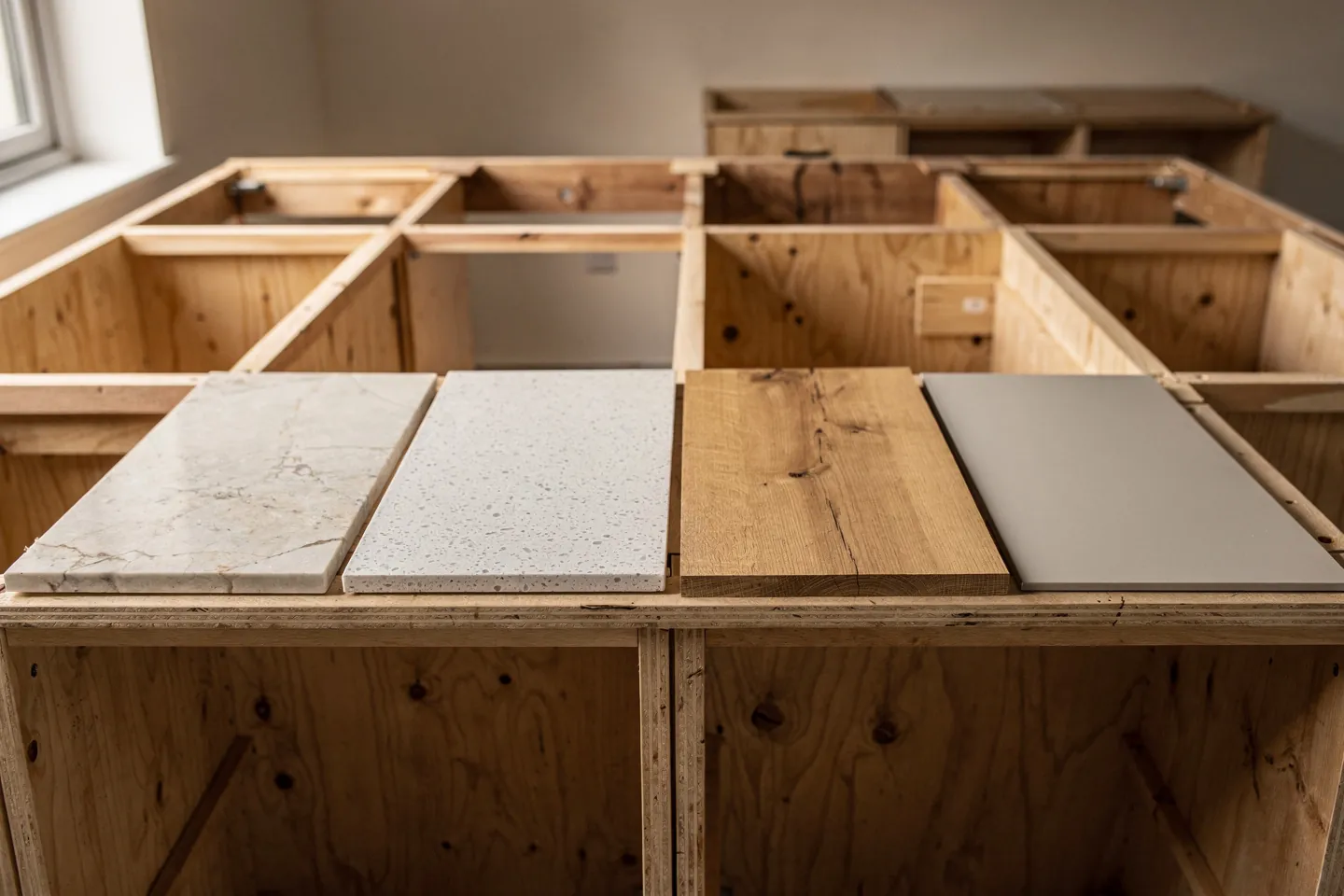
A moodboard helps keep one direction: the worktop, fronts, splashback, floor and hardware have to work together, not each on its own. Photos on a screen distort colour and sheen, though. So I only decide over physical samples laid side by side, in the kitchen itself, in daylight and artificial light. How the floor relates to the worktop is described in Floors: wood, vinyl, microcement.
- Narrow the materials down by how you cook: daily family cooking tolerates different worktops than an occasional breakfast.
- Put together a moodboard with the worktop, fronts, splashback, floor and hardware in one place.
- Take the samples home and look at them under light with the colour temperature the kitchen will have.
- Leave a drop of lemon, oil and coffee on a sample overnight. In the morning you will see more than in the showroom.
- For stone, choose a specific slab at the yard, not just a small sample.
- Before the template is taken, confirm the thickness, joint positions and all cut-outs with the fabricator.