Why is the floor decided earlier than you think?
The question of which floor to put in a house usually comes up only once the plaster is finished. By then most of the important decisions are already behind us. The screed height, the heating system, the position of doors and thresholds, even whether anything under the floor can ever be repaired, were all settled when the floor build-up was designed. The finish is only the last few millimetres to centimetres of the whole assembly, and it behaves according to what it sits on.
This article compares the six groups of materials I deal with most often in practice: wood, vinyl, microcement, polished concrete, terrazzo and natural linoleum. Not by how they look in a photograph, but by how they cope with underfloor heating, moisture, footfall and ten years of ordinary life.
Which materials are on the table and how do they differ?
Wood: solid, engineered and herringbone
Solid wood flooring is a single piece of timber through its full thickness. It can be sanded many times and lasts for decades. Its weakness is movement. Wood takes up and gives off moisture from the air, shrinking in winter and swelling in summer, and the wider and thicker the board, the more it moves.
Engineered wood flooring has a wear layer of hardwood bonded to a stabilising core whose grain runs crosswise. That damps the movement considerably. How many times it can be sanded depends on the thickness of the wear layer, and that is the figure worth asking about before the finish or the colour. For a house with underfloor heating it is, in practice, the standard choice of wood.
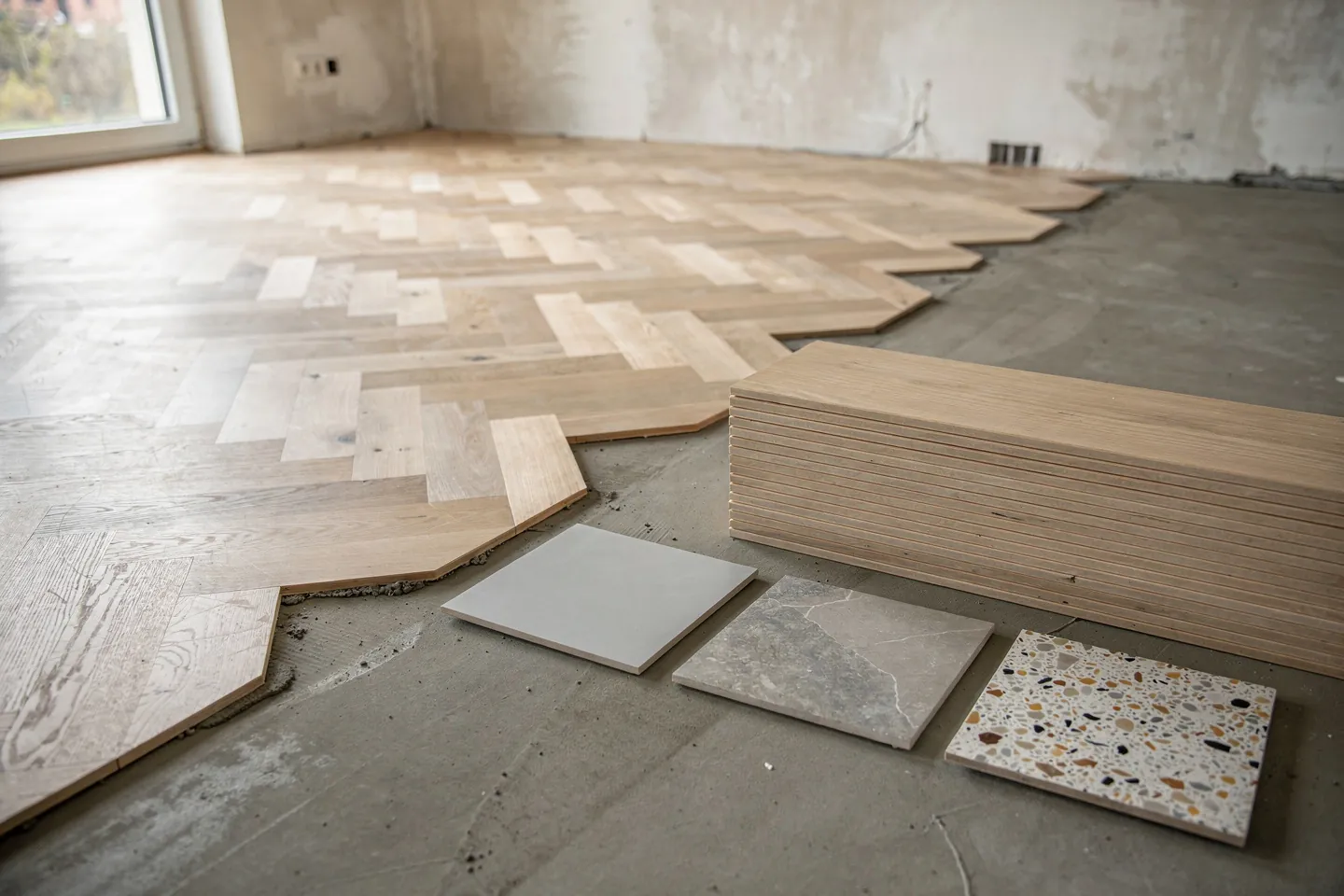
The herringbone parquet pattern is a matter of laying, not of material: it exists in both solid and engineered versions. The short blocks are fully bonded to the substrate, laying takes longer and there is more offcut waste. The result is nonetheless more stable than long floating boards, because the movement of individual blocks is split between two directions.
Vinyl
Vinyl floors (thin glue-down LVT tiles as well as rigid click planks with a mineral core) are PVC-based, with a printed decorative film under a clear wear layer. They are water-resistant and quick to lay. The wood or stone pattern, however, is a photograph: it cannot be sanded, and once the wear layer on the main walking route is worn through, the remedy is replacement. In direct sun behind large glazing, thermal expansion needs watching.
Microcement and polished concrete
Microcement is a thin cement-based coating, trowelled by hand in several layers and sealed with lacquer. It is only a few millimetres thick, so it adds almost no height. It is, however, almost entirely craft: the result depends on the applicator more than with any of the other materials. It mirrors its substrate, so cracks and movement joints in the screed will sooner or later show through.
Polished concrete, by contrast, is a structural layer that is ground and sealed directly. It needs a good-quality concrete slab or a screed designed for the purpose, and an acceptance that hairline cracks and colour variation are part of its look, not grounds for a complaint.
Terrazzo and natural linoleum
Terrazzo is a mix of stone chippings and binder, either poured in place or made as tiles, that is ground and polished. It is hard, heavy and close to indestructible. Natural linoleum is made from linseed oil, wood and cork flour, limestone and resins on a jute backing. It is often confused with vinyl but is a different material: made from renewable raw materials, naturally antistatic, and after laying it carries a temporary yellowish cast that fades in daylight.
| Material | Character | Water and moisture | Repairability |
|---|---|---|---|
| Solid wood | Warm, alive, moves noticeably | Sensitive | Repeated sanding |
| Engineered wood | Warm, more stable | Sensitive, less than solid | Sanding, limited by wear layer thickness |
| Vinyl | Quiet, resilient, repeating pattern | Resistant | Only replacement of a plank or the whole area |
| Microcement | Seamless, thin | Resistant once sealed, lacquer needs renewing | Local repairs tend to show |
| Polished concrete | Raw, with hairline cracks | Resistant | Regrinding and resealing |
| Terrazzo | Hard, cool to the touch | Highly resistant | Regrinding and repolishing |
| Natural linoleum | Matt, warm to the touch | Sensitive to standing water | Surface maintenance, replacing a strip |
How do floors behave over underfloor heating?
For an underfloor heating finish, what matters is its thermal resistance: how much heat it lets through from the screed into the room. The higher it is, the warmer the water the system needs to deliver the same output, and that directly lowers the efficiency of a heat pump. Why the water temperature matters so much is explained in the article heat pump or gas in a new house.
Stone and cement surfaces (microcement, polished concrete, terrazzo) have very low thermal resistance and are the most forgiving over underfloor heating. Thin glue-down vinyl and linoleum are also favourable. Wood insulates more, and its resistance grows with thickness, so over underfloor heating it makes sense to choose a thinner engineered floor, fully bonded, and to avoid thick solid boards. Floating installation on an underlay adds further resistance and an air gap.
The second issue is movement. Wood dries out when the heating runs, gaps open between boards in winter and close again in spring. Manufacturers therefore cap the floor surface temperature and recommend keeping indoor humidity within a reasonable band. Beech and maple react more sharply to changes in humidity, oak is calmer. Rigid surfaces do not move on their own, but they must respect the movement joints in the screed: where there is a joint in the screed, there has to be one in the microcement or terrazzo too.
| Material | Heat transfer | Movement with heating | What to watch |
|---|---|---|---|
| Solid wood | Weakest of those compared | Significant | Board thickness and width, sensitive species |
| Engineered wood | Good when thin and glued | Moderate | Full-surface bonding, surface temperature limit |
| Vinyl | Good | Noticeable when floating | Glue-down version, sun behind windows |
| Microcement | Very good | None of its own, follows the screed | Joints and cracks in the substrate |
| Polished concrete | Very good | None of its own | Cracks in the slab, concrete quality |
| Terrazzo | Very good | None of its own | Movement joints, weight |
| Natural linoleum | Good | Small | Substrate moisture, suitable adhesive |
Why is laying too early the classic failure?
You can walk on a screed after a few days, but it is dry enough for a floor finish much later. Both cement and anhydrite screeds release residual moisture for weeks, longer still with a thicker layer and in cold weather. Lay wood on top and the moisture goes into the wood: boards cup, adhesive loses its bond, bubbles form under vinyl and stains appear in microcement. The schedule in which drying cannot be sped up by any decision is covered in the article house renovation: the order of steps.
The rules are simple:
- Measure, do not guess. Residual moisture is measured with the calcium carbide (CM) method on a sample taken through the full depth of the screed, not with a surface meter. The permitted value is set by the floor and adhesive manufacturer according to the screed type.
- With underfloor heating, commission it first. Before laying, the heating is gradually ramped up and back down again following a protocol that finishes drying the screed and checks whether it cracks.
- Sand anhydrite once it has cured. A thin weak skin forms on the surface that slows drying and reduces adhesive bond.
- Acclimatise the wood. Packs are opened in a house that is already dry and heated, not on a site with wet plaster.
How are impact sound and floating floors handled?
The term floating floor is used in two senses. A floating floor in the construction sense is a screed laid on a resilient layer, separated from both the slab and the walls. That provides impact sound insulation to the room below, and in a house with an upper storey it matters regardless of the finish. The condition is that the screed never touches walls or pipes. A single bridge, such as a badly trimmed edge strip, can noticeably worsen the result.
Floating installation of the finish (click boards on an underlay) is something else. It does little for noise to the storey below, but it changes the sound in the room itself: footsteps sound hollower. A glued floor sounds fuller, transfers heat better and moves less. A floating floor is quicker, can be taken up and does not depend on adhesive. In a house with underfloor heating I choose glued, while for a quick renovation without floor heating floating is a legitimate choice.
What happens at thresholds and transitions between floors?
When wood meets microcement or tiles on the same storey, the difference in finish thickness can exceed a centimetre. If the design does not resolve it, the site resolves it with a transition strip or a threshold, which is exactly what the client wanted to avoid. A flush threshold is not designed at floor level but at screed level: each room gets a screed height matched to the thickness of its finish including adhesive, and that has to be decided before the pour.
Where two materials meet there is always a joint. In rigid surfaces it follows the movement joint in the screed, in wood and floating floors it allows movement. Likewise the perimeter gap along the walls, hidden by the skirting, is not a sloppy fitter but the condition that stops wood lifting in summer. If you want the skirting recessed flush with the wall, the bricklayer and plasterer need to know already.
What does each floor look like after ten years?
- Wood has a patina, scratches along the walking routes and fine gaps in winter. An oiled surface can be refreshed locally, a lacquered one is sanded across the whole room.
- Vinyl looks the same for a long time, then the wear layer and the pattern rub through at the most exposed spots. Repair means replacement, often of the whole area with glue-down vinyl.
- Microcement gathers fine scratches and shinier patches where people walk. The lacquer is renewed, local repairs tend to show, and if the substrate has moved, hairline cracks appear.
- Polished concrete and terrazzo age best. Scratches are ground out, the surface is repolished and the floor serves for further decades.
- Linoleum lasts a long time with regular care, as schools and hospitals demonstrate. It cannot be sanded, but a damaged strip can be replaced.
What drives the cost and how should you decide?
I do not quote prices per square metre here; they change quickly and differ by region. The ranking of the main drivers is stable, though. With microcement and poured terrazzo, most of the cost is labour and the applicator's experience. With wood, the species, grade, wear layer thickness and pattern decide it, herringbone being more labour-intensive than long boards. Vinyl has the cheapest material and installation, but a shorter life. In every case substrate preparation is underestimated: levelling, priming, moisture measurement and sanding the screed.
Wood in the living room, a hard-wearing rigid surface in the kitchen and entrance, and one well-considered transition between them give a house more than a single material used everywhere for the sake of a uniform look.