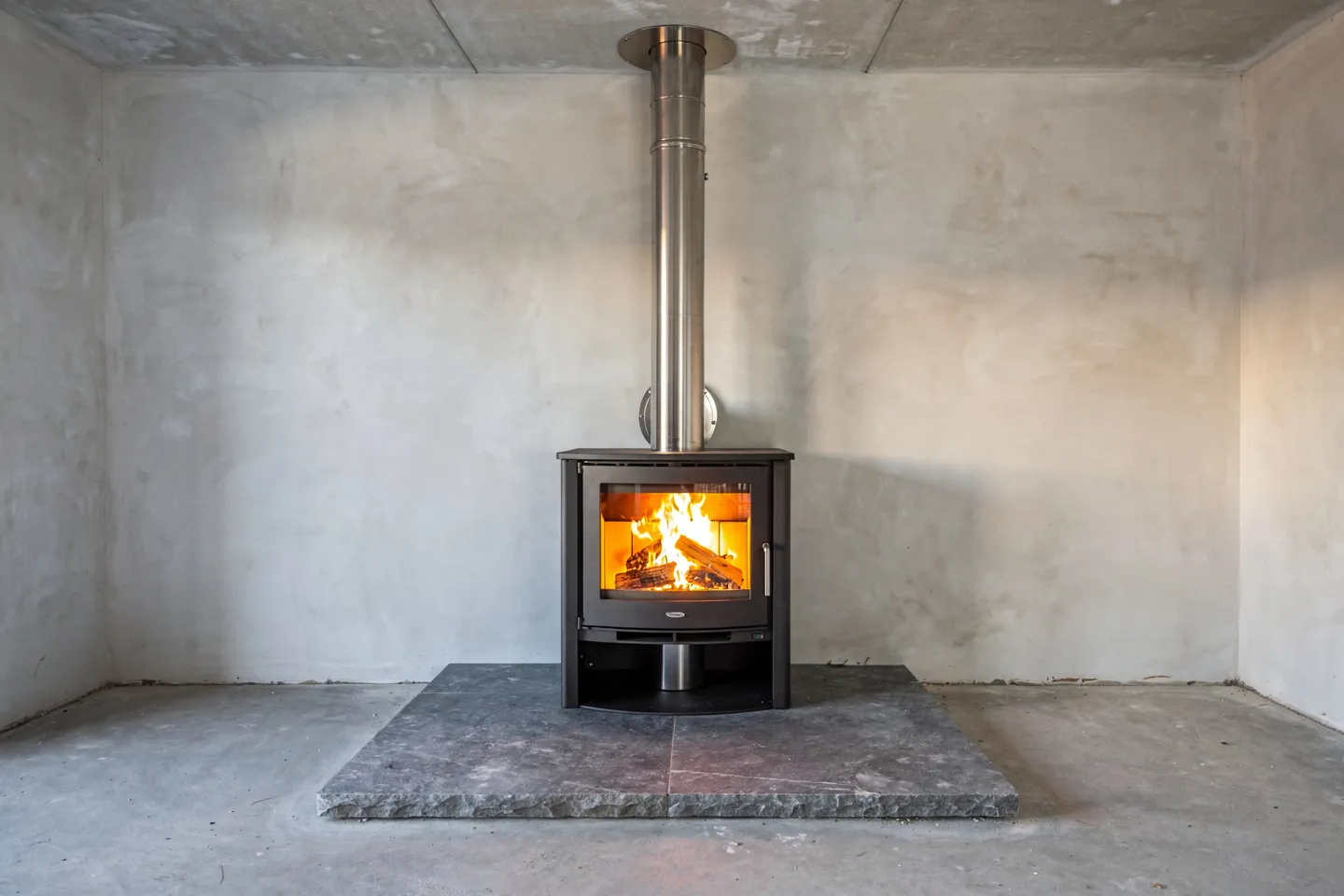
A fire behind glass belongs to the picture of your own house as much as a big window onto the garden. In a new build with a low heating demand, though, a fireplace stops being an obvious heat source and becomes a technical task: it has to fit into a house that barely needs heating, is airtight and is ventilated by a heat recovery unit. If you are working through the whole concept, start with the pillar article passive house from A to Z.
Why does an ordinary stove overheat a low-energy house?
Older houses lost heat quickly, so they were sold stoves and fireplace inserts with an output that could heat the whole ground floor. In a well-insulated house with good windows, the heat loss of the entire building is an order of magnitude lower. The living room in such a house needs, even in frost, only a fraction of what a smaller conventional insert gives off with normal refuelling.
After lighting, the living room temperature climbs, within an hour the room is hot and the windows are opened. Unused heat is vented away.
The first requirement is therefore simple: the useful output must be small, a few kW rather than more, and should match what the living area can absorb, not what would heat the whole house. The second requirement is that the heat reaches somewhere other than the living room. In an open space with the kitchen and the staircase it spreads better; in a closed room it stays put. Heat recovery ventilation will not distribute it around the house, its airflow is far too small for that.
Room-sealed stoves or room-air-dependent ones?
Every fire needs oxygen. A room-air-dependent appliance takes it from the living room, and the air that leaves through the chimney has to get back into the house somehow. In a house with high airtightness no such path exists, so negative pressure builds up in the room easily. When the negative pressure in the house is stronger than the chimney draught, flue gas reverses into the room, often unnoticed and together with carbon monoxide.
The fire itself is not the only thing creating negative pressure. Typical sources are:
- a kitchen hood ducted outside, which on a higher setting extracts more air than the whole ventilation unit supplies;
- exhaust-only ventilation in bathrooms and toilets with no controlled supply air;
- a heat recovery unit with unbalanced airflows, or with frost protection that throttles the supply fan in cold weather;
- a tumble dryer vented outside, or a central vacuum system exhausting outdoors.
Room-sealed stoves, also labelled as independent of room air, have tight doors and their own combustion air supply ducted from outside. The firebox is separated from the room, and negative pressure in the house affects it much less. The exact label matters, though: some stoves only have a spigot for external air but are not certified for room-air-independent operation. Look for the difference in the manufacturer's documentation, not in the sales brochure.
A common safeguard is a differential pressure sensor (a differential pressure switch), which compares the room pressure with outdoors or with the chimney and switches off the hood or the ventilation when a set value is exceeded. Whether your appliance needs one is decided by the stove maker, the ventilation unit maker and the chimney sweep who will assess the chimney. Ask all three, and do so before the stove is ordered. I also cover living with ventilation in heat recovery ventilation in practice.
| Aspect | Room-sealed (independent of room air) | Room-air-dependent |
|---|---|---|
| Combustion air source | Duct from outside straight into the firebox | Air from the living room |
| Sensitivity to negative pressure in the house | Low, if the appliance is certified for this mode | High, risk of flue gas spillage |
| Running alongside heat recovery ventilation | Usually solvable under the makers' conditions | Problematic, often only with a safeguard or operating limits |
| Running alongside a kitchen hood | Recirculating hood or a pressure safeguard advisable | As a rule only with a pressure safeguard or recirculation |
| Effect on envelope airtightness | The air duct is one more penetration to seal and insulate | Needs a permanent air inlet into the room, which undermines airtightness |
| Suitability for a low-energy house | Yes, the default choice | Only exceptionally and after checking with the sweep |
Accumulation stoves or fast steel stoves?
How the appliance releases its output over time matters as much as the output itself. Steel stoves heat up within minutes and give off heat by radiation and convection while the fire burns. The result is an evening output peak that a lightweight interior has nowhere to store.
Accumulation stoves (masonry heaters, tiled stoves, chamotte or stone cores) work the other way round. One intense firing heats a heavy mass, which then releases the heat slowly for many hours after the fire is out. The fire burns briefly and fully, which means cleanly, and the room does not overheat in a jump. Between the two sit steel stoves with an accumulation top made of stone or ceramic, which soften the peak and extend how long heat is released.
In a low-energy house accumulation is an advantage, but it is not free: a masonry core is heavy, needs a ceiling or foundation that can carry it and space in the floor plan. The thermal mass of the house itself also helps, meaning solid walls, ceilings and floors that absorb part of the peak.
| Appliance type | How it releases heat | Fits a low-energy house? |
|---|---|---|
| Open fireplace | In bursts, with low efficiency and high room air consumption | No, it does not work as a heat source and fights the ventilation |
| Fireplace insert without accumulation | Fast start, output peak, cools quickly once out | Only with a small output and as a room-sealed appliance |
| Steel stove | Radiation and convection only while burning | Yes, if small and room-sealed |
| Stove with an accumulation top | Softened peak, keeps releasing heat for several hours | Yes, a good compromise |
| Masonry accumulation heater | Short intense firing, long even heat release | Yes, if there is space, load capacity and a design for low heat loss |
| Water-jacketed stove | Most heat goes into water, only part into the room | Yes, as part of a system with a tank |
| Pellet stove | Continuously modulated output, needs electricity | Yes, in a room-sealed version, if you accept the servicing |
When does a water-jacketed stove with a tank make sense?
A water-jacketed stove sends most of its heat into the heating water and gives off only a smaller share into the room. That solves the overheated living room, and the heat reaches the whole house through underfloor heating or radiators. The water has to go somewhere, though: the appliance is connected to a buffer tank, which stores the heat from one evening while the system draws on it as needed, often together with a heat pump or solar thermal.
This is the most complex of the options. It needs space for the tank, hydraulics with protection against cold return water, a pump, controls and usually a safety cooling loop for the case where the pump stops during a power cut while the fire is still burning. The exact connection is prescribed by the appliance maker. I recommend such a setup only when you genuinely plan to heat with wood regularly. For a few evenings a year it is expensive equipment that sits idle most of the time.
The chimney: system, liner, height and envelope penetration
New houses today almost always get a system chimney: a prefabricated assembly with a chimney liner of ceramic or stainless steel, thermal insulation and an outer casing. The alternative is an insulated twin-wall stainless steel chimney, run inside or up the facade. The cross-section and material of the chimney flue must match the appliance and the fuel. Modern stoves have low flue gas temperatures and therefore need a moisture-resistant chimney, otherwise the flue gas condenses inside it.
A chimney run inside the house, in the warm zone, draws better and condenses less. Where it passes through the airtight layer and the roof insulation, however, a demanding detail appears: a thermal bridge, clearance from combustible materials and a connection to the airtight layer that must not be ordinary tape on a hot surface. System chimneys have their own transition pieces for this, and those belong in the drawings, not in improvisation on the roof. The combustion air duct needs solving too: it is another penetration of the envelope, insulated against condensation and sealed.
The height of the chimney and the position of the chimney head above the roof affect the draught and where the smoke goes, meaning whether you or your neighbour will have it at the upstairs bedroom window. Minimum heights and clearances are set by technical regulations and the system maker. Both chimney and appliance belong in the project documentation, including the fire safety design, and before the first fire a chimney sweep inspects the chimney and issues a report. During an airtightness test the chimney and the air supply are sealed, so the result tells you nothing about how tight they are.
Fine particulates and air quality
Wood is a renewable fuel, but burning it in small appliances is a significant source of fine particulate matter. In Slovak basins this shows up in the air of the whole village during winter inversions. New solid-fuel local space heaters sold in the EU must meet Ecodesign requirements, which limit both emissions and low efficiency. When choosing, look for proof of compliance with these requirements.
The rest comes down to operation: dry wood, ideally checked with a moisture meter, lighting from the top, enough air while burning and never waste, painted or glued wood. Throttled overnight smouldering is exactly what drives emissions up the most.
A fireplace also affects indoor air quality. Refuelling lets a little smoke into the room, and cleaning out ash stirs up dust. A room-sealed appliance with a chimney that draws well keeps this to a minimum, the ventilation gradually removes the rest and its filters catch part of the dust. In a season when you burn wood, check them more often.
When a fireplace is a pleasure, not heating
In a low-energy house it is perfectly fine to admit that you want a fire for the atmosphere. The main heat source remains a heat pump or another system designed for the whole house, and the stove burns on a few winter evenings. You only need to choose an appliance that fits this role: small, room-sealed, with a good view of the flames and with a pressure safeguard if the makers require one.
If the fire also serves as a backup during a power cut, that is a sensible bonus. Room-sealed log stoves work without electricity; pellet stoves and water-jacketed stoves do not without further measures.
The order that works:
- Decide whether it is for heating, backup or atmosphere, and choose the appliance type accordingly.
- Choose a small-output appliance certified for room-air-independent operation.
- Check the conditions for running alongside ventilation and for a pressure safeguard with the stove maker, the ventilation unit maker and the chimney sweep.
- Design the route of the chimney and the air supply together with the floor plan, the structure and the airtight layer.
A fireplace designed this way will not overheat the house, will not fight the ventilation, and you will still enjoy using it ten years from now.